
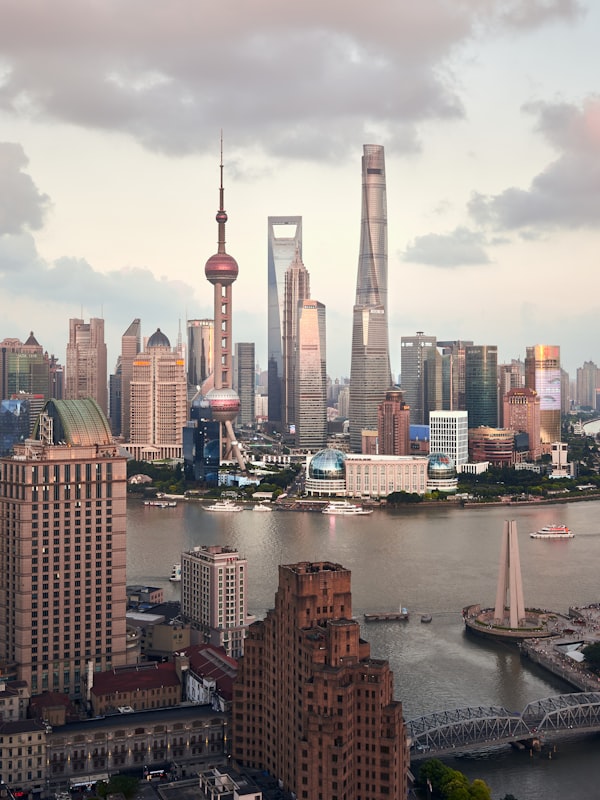
Country dossier · Living
🇨🇳 China
Living guide: real net salary, cost of living, taxes, health and quality of life, with source for every figure.
- Region
- East Asia
- Capital
- Beijing
- Languages
- Mandarin (official), with relevant regional varieties such as Cantonese
- Currency
- Yuan (CNY)
- Population
- ≈ 1.41 billion
- Time zone
- UTC+8 (single time zone for the entire country, despite territory spanning 5 geographic time zones)
- Blocs
- Member of the G20 and UN Security Council; does not integrate formal regional blocs such as EU or ASEAN
China is a paradoxical destination for foreigners considering living there. The job market offers opportunities concentrated in specific sectors such as language teaching, technology, and international trade, particularly in first-tier metropolises. Cost of living varies radically between Beijing, Shanghai, or Shenzhen, where living can be as expensive as major Western cities, and smaller cities, where it offers real purchasing power advantages. The reality includes practical challenges with restrictions on access to Western internet services (Google, social media), which impacts professional and personal routine. For employed foreigners, the experience varies greatly depending on the industry, company size, and personal willingness to adapt to distinct institutional contexts.
China at a glance
Languages and regions
Mandarin is the official and required language for practical life, but China is linguistically diverse. Cantonese, spoken primarily in Hong Kong and Guangdong, remains a second language of significant cultural and economic weight. Other regional varieties such as Shanghainese exist, but Mandarin will dominate your daily experience. Foreigners in large cities encounter bubbles where English works in commercial areas and in some international companies, but do not rely on it for daily life. The ability to read Chinese characters is essential for urban navigation, from reading menus to signing contracts. Learning at least basic Mandarin phrases is highly recommended not just from practical necessity, but as social currency for integration.
Climate and geography
China's continental size creates extreme climate variations. Beijing experiences dry, harsh winters, with air pollution as a historical seasonal concern, and hot, humid summers. Shanghai and the Yangtze River delta have humid subtropical climate, with very hot summers and monsoon rains. The tropical south offers warmer year-round climates. Air pollution, while improving significantly in the past decade, remains a relevant factor in large cities, especially in the north during winters. The vast latitude also means significant variations in available sunlight: Beijing has much shorter days in winter compared to the south of the country. For those coming from temperate climates, physiological adaptation to the extremes is real.
What drives the economy
China maintains a gigantic and highly diversified economy, being the world's largest manufacturer and exporter of goods, as well as a power in technology, digital commerce, and infrastructure. Shenzhen has established itself as a hub for electronics innovation and startups. Hangzhou is the center of digital commerce and e-commerce platforms. Beijing concentrates creative industries, technology, and public administration. Shanghai remains the financial heart. For foreigners, the most historically accessible opportunities were English teaching or other languages, but the sector now faces increasingly restrictive regulation. Technology, international consulting, and bilateral trade offer alternatives with better compensation. The domestic economy is robust, but access for foreigners to certain sectors and career progression can be structurally limited without Chinese nationality.
Education
The Chinese education system emphasizes academic rigor, memorization, and extreme competition. International schools exist in large cities and serve expats with Western teaching standards, but charge high tuition. For foreigners' children, this is generally the only viable option outside of Mandarin language. Top Chinese universities rank among the world's best in research, especially in engineering and sciences, and some offer English-language programs for international students. If you consider bringing children or think about continuing education, the cost of international schools is a relevant factor in calculating feasibility. Chinese government scholarships for foreigners exist and are competitive.
Culture and integration
Integration of foreigners into China is pragmatic but not assimilationist. Large cities have established expat communities with their own social life, which offers network and comfort, but can also isolate from local society. The household registration system (hukou) historically created two urban classes, a reality that also affects foreigners in access to public benefits. Cultural life is rich in traditional events, but Western festivals receive less official visibility. Building deep friendships with Chinese people is possible, but requires time and genuine willingness to learn the culture. Networks of relationships and personal connections (guanxi) are relevant social and professional currency. Western religions have limited and regulated presence; Chinese spiritual practices (Taoism, Buddhism) are culturally present but also under state scrutiny.
Fun facts
- The Great Wall of China extends for over 21,000 kilometers, making it one of the most colossal structures ever built by humanity.
- Beijing was a capital carefully planned and built over centuries, with urban structure based on Taoist principles of geomancy and axial symmetry.
- China invented paper, printing, gunpowder, and the compass, technologies that transformed the world for centuries before reaching the West.
- Shenzhen transformed from a village of 30,000 people in 1979 into a metropolis of over 12 million in less than 40 years, as a special economic zone.
- Chinese cuisine varies radically between regions, both in ingredients and techniques, to the point where gastronomic dialects are as different as languages.
Net salary, summarized
Source: national medians (OECD/Eurostat) + calculator formulaJust to show the ballpark of what you earn. Tax and cost of living take a chunk. Three sample professions, junior to senior. The full calculation, for your role, level, family, and currency, is the Living calculator.
| Profession | Junior | Mid | Senior |
|---|---|---|---|
| Software developer | US$ 1.907 | US$ 2.356 | US$ 3.561 |
| Financial analyst | US$ 1.462 | US$ 1.809 | US$ 2.740 |
| Nurse | US$ 1.312 | US$ 1.624 | US$ 2.462 |
Estimated net monthly, after progressive tax, in dollars (site base). Calculate for your role, level, and currency →
Cost of living, what you actually keep
Source: basket for couple + 2 children (Numbeo) + local health and school rules| Housing (rent)≈ 40% of cost | US$ 1.560 |
| Food | US$ 842 |
| Transport | US$ 351 |
| Utilities and internet | US$ 304 |
| Recreation and other | US$ 842 |
| Healthcare (private plan required)fixed cost, does not decrease with lower income | US$ 200 |
| Children's school | US$ 3.667 |
| Total cost per month | US$ 7.767 |
Spending pattern (housing + living only)
Local tax, health, and school rules change how much is left at month end.
Family and immigration
Visa and spouse work rules; local values estimatedQuality of life
Indices: GPI, PISA, WHO, WHR, Ookla, EF EPI, CPI (0 to 10)Life
Daily
Institutions
Verdict
China offers a unique professional experience and, for specific profiles with salaries at multinational corporations or digital entrepreneurs, access to a dynamic job market and accelerated technological innovation. The cost of living in large cities can be competitive with Western metropolises if you manage location well. However, the challenge is not merely financial or logistical: restrictions on access to Western internet services, a regulatory environment for foreigners that has become more restrictive over the past decade, profound language barriers, and the need to obtain corporate sponsorship for legal residence make China a destination that requires strong compatibility with local reality. It is a country that rewards those who genuinely commit to learning its language and dynamics, but does not forgive those who expect a Westernized environment.
Complete guide: China
This page is the sample. The guide is the complete map.
Everything you saw here, deeper and actionable: from first visa step to moving day, sourced for every fact.
- Visa and sponsorship, step by step
- Cities and regions compared
- Health insurance: how to choose
- Retirement, taxes, and local rules
- Useful links: housing, bank, jobs
Imagine yourself here.
Photos: Siyuan Hu, Maud Beauregard, Yiran Ding · Unsplash
Frequently asked questions
How does the work visa in China work?
The work visa (Z visa) requires sponsorship from a registered Chinese employer with the authorities. The process involves approval from a local government labor resources agency and can take weeks to months. You cannot simply look for work in China on a tourist visa and then convert it; the visa needs to be obtained abroad before entry, or in specific cases while already in the country with another visa. The employer bears part of the bureaucracy, but legal responsibility for compliance is shared. After obtaining legal residence through a work visa, it is possible to renew as long as you maintain employment.
Can my partner or spouse work legally if I get a work visa?
Yes, but with caveats. A spouse can apply for a dependent visa (family reunion visa) and, with that visa, apply for their own work authorization from local authorities. The process, however, is independent and also requires sponsorship. Some companies and regions are more receptive to allowing spouses to work, while others impose barriers. It is not automatic and it is recommended to check with the local labor resources agency (Bureau of Human Resources and Social Security) of your destination city before moving.
How does public health work and what is access for foreigners?
China has a subsidized public health system, but foreigners frequently use private clinics or international hospitals in large cities, where quality is high but costs are significant. Some employers offer private health insurance as a benefit, which is highly recommended. Public coverage for foreigners depends on visa type and local registration, and is generally limited. Prescription medications work differently than in the West and access to specific drugs can be complicated. It is recommended to have robust international health insurance and familiarize yourself with trusted hospitals in your city before needing them.
What are the main challenges with internet access and communication?
China has a 'great firewall' that blocks access to many Western services: Google, Gmail, Facebook, Instagram, YouTube, and most Western social networks require VPN to function, and even then not always reliably. This affects remote work for Western companies, communication with family, and access to content. Using VPN is a common practice among expats but technically is not explicitly regulated and its legal status is ambiguous. WhatsApp functions intermittently. Local services (WeChat for everything, Alipay for payments, Douyin for videos) are robust, but require adaptation. For those working with global teams or depending on Western tools, this is a critical day-to-day reality.
Ready to go beyond the summary?
View the complete guide: China