
Country dossier · Living
🇩🇰 Denmark
Living guide: real net salary, cost of living, taxes, health and quality of life, with source for every figure.
- Region
- Northern Europe (Scandinavia)
- Capital
- Copenhagen
- Languages
- Danish, English widely spoken
- Currency
- Danish Krone (DKK)
- Population
- ≈ 6 million
- Time zone
- UTC+1 (CET)
- Blocs
- EU + Schengen
Denmark beats most European countries in social well-being: generous parental leave, free education through university and solid public health. Everything has a price, however. Taxes on salary and consumption rank among Europe's highest, and Copenhagen competes with other Nordic capitals for the most expensive housing. The Danish trick is real, but works mainly for those already well established.
Denmark at a glance
Languages and regions
Danish is the official language, but English is so widespread that anyone with formal education speaks with fluency. In Copenhagen and in technology and finance sectors, English is accepted in daily work, mainly in startups and multinationals. Outside Copenhagen, the local language weighs more, though access to English speakers remains reasonable in medium-sized cities.
Climate and geography
Flat country, no mountains, defined by coastlines and islands. The climate is temperate oceanic, with mild winters (but cloudy and long) and brief summers. Copenhagen is on the island of Zealand, near the Oresund Strait, which separates it from Sweden. The lack of relief and proximity to water make the bicycle the main transport in many cities.
What the country lives on
Balanced economy between industry, finance and services. Denmark is strong in engineering, renewable energy (wind turbines and sustainability research), design, and well-being and health sectors. Has its own business model, values innovation and sustainability, which attracts technology companies and talent, but most sectors value qualified workforce residing long-term, not constant migration.
Education
Free public education, from childcare through university, with parallel vocational education well structured. The system is less competitive than in other European countries, focused on integral development. Working while studying is common practice and well accepted. Universities have good quality, with emphasis on applied research.
Culture and integration
Danish culture values equality, efficiency, and communal social life (the concept of 'hygge' is almost an obsession). Punctuality is expected, but the work environment is less hierarchical than in many other European countries. Immigration policy has changed significantly in recent years and become more restrictive for those not coming from within the EU or without specific sought-after qualifications.
Fun facts
- Copenhagen has a historic and bold neighborhood of occupation and counterculture (Christiania) that, despite police conflicts, remains as alternative space within a very ordered city.
- The 'hygge' is not just a word, it's a concept of well-being and coziness that permeates Danish social life and design.
- Denmark has the highest penetration of wind turbines in the world relative to size, and around 80% of electricity comes from renewable sources, with wind alone accounting for about 60% of generation.
- The tax system is progressive, but even with high salaries, the deduction for taxes and health insurance is substantial.
- Cycling is so common that cities have bicycle infrastructure at the level of automobiles in many countries.
Net salary, summarized
Source: national medians (OECD/Eurostat) + calculator formulaJust to show the ballpark of what you earn. Tax and cost of living take a chunk. Three sample professions, junior to senior. The full calculation, for your role, level, family, and currency, is the Living calculator.
| Profession | Junior | Mid | Senior |
|---|---|---|---|
| Software developer | US$ 4.818 | US$ 5.756 | US$ 8.136 |
| Financial analyst | US$ 3.832 | US$ 4.605 | US$ 6.515 |
| Nurse | US$ 3.486 | US$ 4.197 | US$ 5.968 |
Estimated net monthly, after progressive tax, in dollars (site base). Calculate for your role, level, and currency →
Cost of living, what you actually keep
Source: basket for couple + 2 children (Numbeo) + local health and school rules| Housing (rent)≈ 38% of cost | US$ 1.938 |
| Food | US$ 1.138 |
| Transport | US$ 474 |
| Utilities and internet | US$ 411 |
| Recreation and other | US$ 1.138 |
| Healthcare | included |
| Children's schoolpublic viable for non-residents | included |
| Total cost per month | US$ 5.100 |
Spending pattern (housing + living only)
Local tax, health, and school rules change how much is left at month end.
Family and immigration
Visa and spouse work rules; local values estimatedQuality of life
Indices: GPI, PISA, WHO, WHR, Ookla, EF EPI, CPI (0 to 10)Life
Daily
Institutions
Verdict
Worth it for qualified professionals in technology, education or health who get work visa and attract employer from outside EU, or EU/EEA citizens. High cost of living and taxes cut much of the advantage of nominally good Danish salary. Worth less for those starting career or with modest income: fixed expenses (housing, taxes) absorb quickly. The integration point is challenging for those not coming from within EU: immigration policies became stricter and Danish social cohesion, though strong, is not automatic for outsiders.
Complete guide: Denmark
This page is the sample. The guide is the complete map.
Everything you saw here, deeper and actionable: from first visa step to moving day, sourced for every fact.
- Visa and sponsorship, step by step
- Cities and regions compared
- Health insurance: how to choose
- Retirement, taxes, and local rules
- Useful links: housing, bank, jobs
Imagine yourself here.
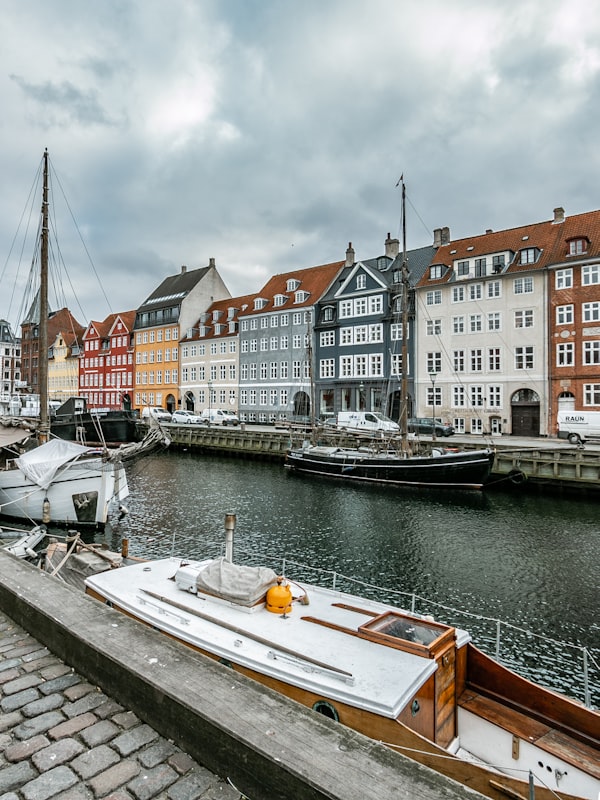
Photos: Zachary Shakked, Sabrina Mazzeo, Julia Cheperis · Unsplash
Frequently asked questions
Do I need to speak Danish to work there?
In technology sectors and multinationals in Copenhagen, no. English is sufficient for work and much of Copenhagen functions in English. Outside these sectors and cities, Danish weighs more. Learning the language helps a lot with social integration.
What is the health system like in Denmark?
Public and free for residents. Access is through family doctor (the GP, general practitioner), who triages for specialists. Quality is high, wait times vary by region. Emergencies have no queue, but elective surgeries can have weeks of wait.
Can I bring my family if I work there?
Yes, spouse and children are entitled to family reunion, but there are minimum income requirements and adequate housing. Paternity documents are mandatory. The process is less bureaucratic within the EU.
Do high taxes really cut the salary?
Yes, significantly. Income taxes and social security take between 38% and 56% of gross, depending on salary. There is tax credit and benefits, but net is considerably less than announced.
Ready to go beyond the summary?
View the complete guide: Denmark