
Country dossier · Living
🇳🇱 Netherlands
Living guide: real net salary, cost of living, taxes, health and quality of life, with source for every figure.
- Region
- Western Europe
- Capital
- Amsterdam
- Languages
- Dutch, English widely spoken
- Currency
- Euro (EUR)
- Population
- ≈ 18 million
- Time zone
- UTC+1 (CET)
- Blocs
- EU + Schengen
The Netherlands is expat-friendly by design: they speak English, have flexible work visas for qualified people, and the tax system has special exception for immigrants (30% ruling). Cost of living in Amsterdam and Rotterdam goes up quickly, but salaries also follow. The trick is that the country is small, tight, and not everyone tolerates life on a bicycle and without privacy of space.
Netherlands at a glance
Languages and regions
Dutch is the official language, but almost every Dutch person with formal education speaks English with near-native fluency, a unique cultural trait in Europe. In Amsterdam, Rotterdam and Utrecht, especially in startups, technology and finance, work is entirely in English. Outside major cities, Dutch weighs more, but English penetration is still very high compared to other continental nations.
Climate and geography
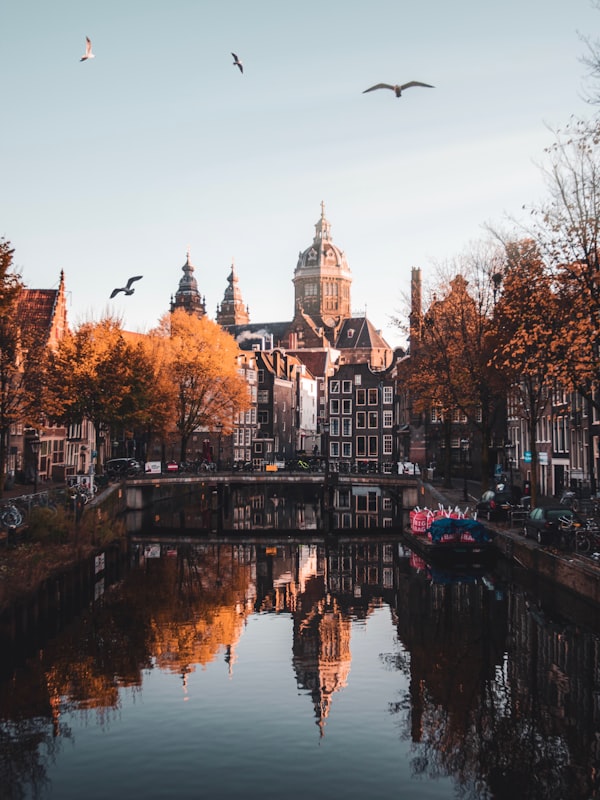
Completely flat country, built on land reclaimed from sea and rivers, surrounded by dikes. The climate is temperate oceanic, with mild but rainy winters, brief summers. Amsterdam is famous for its canals. Most population is concentrated in the west (Randstad: Amsterdam, Rotterdam, Utrecht). Bicycle is not a hobby, it's dominant transport infrastructure.
What the country lives on
Diversified economy, strong in trade and distribution (Port of Rotterdam is one of the world's largest), finance, technology, agriculture and engineering. It is European hub for American and Asian multinationals. Has historical tradition of commercial openness and tolerance, which attracts international companies and talent. Many global corporation headquarters are in Amsterdam and Rotterdam.
Education
Public education is free or low-cost through higher education. The system divides students early into tracks (VMBO, HAVO, VWO), a structure that may seem rigid but works well to channel talent. Vocational education is valued as much as university. Universities have strong reputation, especially in engineering and applied research.
Culture and integration
Dutch culture values democracy, equality, pragmatism and direct frankness. Work is less hierarchical than in many other European countries. Society is very secular. Politically, there is clear division between left, right and centers, with strong participation in public deliberations. Activism is common practice, from bicycles to neighborhood associations.
Fun facts
- Dutch speakers speak English so well that many immigrants complain of never learning Dutch because nobody forces them to use it.
- The 30% ruling offers a 30% tax reduction on part of the salary for qualified immigrants for up to 5 years, a policy designed to attract international talent; from 2027 the rate drops to 27% for those who entered the scheme in 2024 or later.
- Amsterdam has more bicycles than people, and bicycles are stolen or fall into canals frequently.
- The country is famous for legal tolerance of soft drugs and regulated prostitution, policies that reflect a pragmatic and liberal approach.
- Football is almost a religion: Ajax, PSV and Feyenoord have passionate fans and historic rivalries.
Net salary, summarized
Source: national medians (OECD/Eurostat) + calculator formulaJust to show the ballpark of what you earn. Tax and cost of living take a chunk. Three sample professions, junior to senior. The full calculation, for your role, level, family, and currency, is the Living calculator.
| Profession | Junior | Mid | Senior |
|---|---|---|---|
| Software developer | US$ 4.305 | US$ 5.199 | US$ 7.505 |
| Financial analyst | US$ 3.386 | US$ 4.106 | US$ 5.937 |
| Nurse | US$ 3.067 | US$ 3.724 | US$ 5.404 |
Estimated net monthly, after progressive tax, in dollars (site base). Calculate for your role, level, and currency →
Cost of living, what you actually keep
Source: basket for couple + 2 children (Numbeo) + local health and school rules| Housing (rent)≈ 40% of cost | US$ 1.920 |
| Food | US$ 1.037 |
| Transport | US$ 432 |
| Utilities and internet | US$ 374 |
| Recreation and other | US$ 1.037 |
| Healthcare (private plan required)fixed cost, does not decrease with lower income | US$ 350 |
| Children's schoolpublic viable for non-residents | included |
| Total cost per month | US$ 5.150 |
Spending pattern (housing + living only)
Local tax, health, and school rules change how much is left at month end.
Family and immigration
Visa and spouse work rules; local values estimatedQuality of life
Indices: GPI, PISA, WHO, WHR, Ookla, EF EPI, CPI (0 to 10)Life
Daily
Institutions
Verdict
Worth it for qualified professionals who want an expat-friendly environment and European stability. Salaries are good, taxes are moderate (compared to Nordic countries), and the 30% ruling makes the numbers even better at the start. Housing costs in Amsterdam now compete with London, Zurich and Geneva, so net balance depends a lot on salary achieved. Point of caution: the country is small, tight (approximately 18 million people in 41 thousand km2), bicycle traffic is real, and space privacy is a privilege of those with high income.
Complete guide: Netherlands
This page is the sample. The guide is the complete map.
Everything you saw here, deeper and actionable: from first visa step to moving day, sourced for every fact.
- Visa and sponsorship, step by step
- Cities and regions compared
- Health insurance: how to choose
- Retirement, taxes, and local rules
- Useful links: housing, bank, jobs
Imagine yourself here.
Photos: Matheo JBT, Matheo JBT, Matheo JBT · Unsplash
Frequently asked questions
Do I need to speak Dutch to work in the Netherlands?
In multinationals and technology startups in Amsterdam or Rotterdam, no, English is sufficient. Outside these sectors and cities, there is advantage to speaking Dutch. Many immigrants don't learn because English works, but social integration is easier with the language.
How does the 30% ruling work?
It's a tax exemption that reduces 30% of gross salary (up to a limit) for qualified immigrants for up to 5 years. Available to foreign residents earning above a salary floor and working for registered Dutch employer. It's automatic if you meet the criteria.
What is the rental cost in Amsterdam?
One-bedroom apartment rental in central neighborhood can start from EUR 1,800 to 2,500 per month; outside the center it drops to EUR 1,200 to 1,800. Amsterdam is expensive, comparable to other major European capitals.
Is the bicycle really mandatory?
For short commutes in large cities, yes, it's the most practical and cheap way. Cars are expensive (taxes, fuel, parking), public transport is good but bicycle is the standard. Not mandatory, but it's the dominant cultural norm.
Ready to go beyond the summary?
View the complete guide: Netherlands