
Country dossier · Living
🇭🇺 Hungary
Living guide: real net salary, cost of living, taxes, health and quality of life, with source for every figure.
- Region
- Central Europe
- Capital
- Budapest
- Languages
- Hungarian
- Currency
- Hungarian Forint (HUF)
- Population
- ≈ 9.5 million
- Time zone
- UTC+1 (CET)
- Blocs
- EU + Schengen (outside eurozone)
Hungary is an attractive destination for those seeking low cost of living while maintaining access to the infrastructure and security of the European Union. Budapest, a vibrant and well-preserved capital, concentrates most opportunities for modern and internationalized employment, while interior regions offer even more economical alternatives. Local salaries, while below Western European averages, align with relatively low cost of living, creating a balance that particularly favors those working remotely or receiving remuneration in strong currency. Hungarian language is notoriously challenging to learn, which reinforces the role of English in the urban professional environment, though it remains a genuine barrier to deeper social integration.
Hungary at a glance
Languages and regions
Hungarian is the official language and one of Europe's most linguistically isolated, belonging to the Finno-Ugric family rather than Indo-European groups. This uniqueness means that language-based integration is a genuine challenge for non-speakers, but English is widely diffused among youth and professionals in Budapest, especially in technology, finance, and tourism sectors. Outside the capital, Hungarian dominates more clearly, making language learning necessary for comfortable daily life. The country presents distinct cultural regions: the mountainous north with Central European influence, the agrarian and viticultural east, the south with Balkan nuances, and the central region where Budapest is the economic and cultural epicenter.
Climate and geography
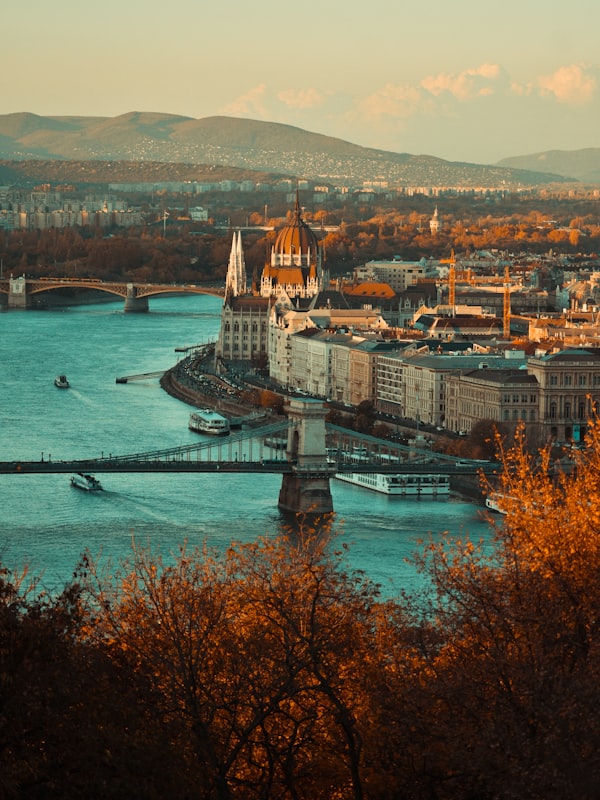
Hungary has a moderate continental climate, with cold winters (averaging 0°C to 5°C in January) and warm summers (averaging 20°C to 25°C in July). Snow is common in winter, while spring and autumn are mild and pleasant. The country has no sea access but possesses Lake Balaton, an important recreation and domestic tourism destination. The landscape is predominantly flat, dominated by the Great Hungarian Plain, with the Danube River running north to south across the country, dividing Buda, the western bank with historic hills, from Pest, the eastern bank flat and modern, creating the iconic and romantic geography of Budapest.
What the country lives from
The Hungarian economy combines specialized manufacturing (automobiles, electronic components, machinery), financial services, and cultural tourism. Budapest is the undisputed economic engine, housing headquarters of major multinationals, a growing technology sector, and startups attracting European investment. The country is less developed than Austria and Germany but more dynamic than many Eastern European neighbors, benefiting from its strategic position in the EU. Tourism contributes significantly, with Budapest attracting roughly four million annual visitors. Agriculture maintains weight in interior regions, especially in wine production.
Education
The Hungarian education system is free through higher education and well-structured, with compulsory education until age 16. Public universities are accessible to residents, often offering entire programs in English to attract international students. The Budapest University of Technology and Economics (BME) and the Eötvös Loránd University are internationally recognized institutions. Higher education is significantly subsidized for EU citizens under certain duration conditions. Private alternatives exist and offer entirely English-taught programs, especially in Budapest, serving expatriate communities.
Culture and integration
Hungarian culture is rich in medieval history, classical music (birthplace of composers like Bartók and Kodály), and visual arts. The public thermal baths, such as the renowned Széchenyi Thermal Bath, are a central social institution and part of the wellness lifestyle. The culinary scene is strong, with traditional dishes like goulash, paprika in everything, and influences from neighboring cultures. The urban population, especially in Budapest, is cosmopolitan and relatively open to immigrants, particularly those working in internationalized sectors. Consolidated expatriate communities exist in Budapest, offering networks of support and socialization.
Fun facts
- Budapest is known as the City of Baths, with more than a dozen thermal water complexes of geological origin, some operating for centuries and transforming public baths into a social and therapeutic experience.
- Hungarian is not an Indo-European language, unlike most of those spoken in Europe, and belongs to the Uralic family alongside Finnish and Estonian, which leaves it isolated even for speakers of neighbouring languages, which makes learning it genuinely challenging.
- The modern capital was formed in 1873 by the fusion of three historically distinct cities (Buda, Óbuda, and Pest), creating a metropolis with one of the most beautiful river panoramas in continental Europe.
- Hungary is the birthplace of classical musicians and composers who defined European musical modernism, including Béla Bartók and Zoltán Kodály, whose works explored Hungarian folk music.
- The country belongs to the European Union and the Schengen area but maintains its own currency (Hungarian Forint), refusing to adopt the euro, which provides currency protection for residents receiving salaries in other currencies.
Net salary, summarized
Source: national medians (OECD/Eurostat) + calculator formulaJust to show the ballpark of what you earn. Tax and cost of living take a chunk. Three sample professions, junior to senior. The full calculation, for your role, level, family, and currency, is the Living calculator.
| Profession | Junior | Mid | Senior |
|---|---|---|---|
| Software developer | US$ 1.516 | US$ 1.844 | US$ 2.689 |
| Financial analyst | US$ 1.182 | US$ 1.443 | US$ 2.118 |
| Nurse | US$ 1.068 | US$ 1.304 | US$ 1.920 |
Estimated net monthly, after progressive tax, in dollars (site base). Calculate for your role, level, and currency →
Cost of living, what you actually keep
Source: basket for couple + 2 children (Numbeo) + local health and school rules| Housing (rent)≈ 33% of cost | US$ 924 |
| Food | US$ 675 |
| Transport | US$ 281 |
| Utilities and internet | US$ 244 |
| Recreation and other | US$ 675 |
| Healthcare | US$ 30 |
| Children's schoolpublic viable for non-residents | included |
| Total cost per month | US$ 2.830 |
Spending pattern (housing + living only)
Local tax, health, and school rules change how much is left at month end.

Family and immigration
Visa and spouse work rules; local values estimatedQuality of life
Indices: GPI, PISA, WHO, WHR, Ookla, EF EPI, CPI (0 to 10)Life
Daily
Institutions
Verdict
Living in Hungary is an economical and viable option within Europe for those who value low cost of living, full access to EU infrastructure and security, plus urban quality of life in Budapest. The capital offers gastronomy, vibrant culture, and growing professional opportunity in modern sectors, while smaller regions guarantee tranquility at an even lower price. The greatest challenge is the Hungarian language, a genuine barrier to deeper social integration and employment opportunities outside the international circle, requiring genuine dedication to learn. Local salaries are low compared to Western Europe but are fully compensated by low cost of living, making the experience advantageous especially for remote workers in strong currency, internationalized expatriates, or professionals in technology sectors.
Complete guide: Hungary
This page is the sample. The guide is the complete map.
Everything you saw here, deeper and actionable: from first visa step to moving day, sourced for every fact.
- Visa and sponsorship, step by step
- Cities and regions compared
- Health insurance: how to choose
- Retirement, taxes, and local rules
- Useful links: housing, bank, jobs
Imagine yourself here.
Photos: Keszthelyi Timi, Keszthelyi Timi, Florian van Duyn · Unsplash
Frequently asked questions
How does the work visa process work for those outside the European Union?
Those who are not EU citizens need to obtain a work visa, usually sponsored by a Hungarian employer. The process involves documentation of the job offer, proof of relevant qualifications, and consular procedures in your home country. Work visas are granted for periods ranging from one to three years, with possibility of renewal. Spouses and partners can apply for family dependency visas, allowing residence during the work visa period. The process is less automatic than within the EU, requiring advance planning and coordination with the employer.
Can my spouse or partner also work while I'm there?
Yes, if your spouse or partner is an EU citizen, they have automatic right to work in Hungary without any additional authorization. If they come from outside the EU, they need to obtain their own work visa sponsored by a local employer, which can be coordinated simultaneously. Some spouses of EU workers obtain a dependency visa that does not automatically authorize work but can apply for separate work permission from Hungarian immigration authorities, usually with less difficulty than independent candidates.
What is the cost of living difference between Budapest and the rest of Hungary?
Budapest is significantly more expensive than the rest of the country, with rent in expatriate-popular neighborhoods potentially double that of smaller cities, while food and transport are also higher in tourist centers. Outside the capital, cost of living is thirty to fifty percent lower, making cities like Debrecen, Szeged, or Pécs genuinely economical options. Even in Budapest, total cost remains below many Western European countries like Austria or Switzerland. Those seeking maximum economy without sacrificing quality of life choose interior regions or medium-sized cities with access to professional opportunities via remote work.
How difficult is it to learn Hungarian and is it possible to survive with English only?
Hungarian is famously challenging, with eighteen grammatical cases, vocabulary rarely borrowed from nearby languages, and a structure completely distinct from Indo-European languages, making learning the essentials an effort of several months of dedication and fluency a project of years. In Budapest, especially in internationalized sectors (technology, finance, education), it is possible to work and live comfortably with English, as the professional environment is widely Anglophone. Outside the capital, the reality changes significantly and Hungarian becomes practically necessary for comfortable daily interactions with neighbors, shops, and administration. Those planning long-term residence should count on learning the language as an essential investment for real integration.
Ready to go beyond the summary?
View the complete guide: Hungary