
Country dossier · Living
🇯🇵 Japan
Living guide: real net salary, cost of living, taxes, health and quality of life, with source for every figure.
- Region
- East Asia
- Capital
- Tokyo
- Languages
- Japanese
- Currency
- Yen (JPY)
- Population
- ≈ 123 million
- Time zone
- UTC+9 (JST)
- Blocs
- Outside the EU; no equivalent regional bloc
Japan offers security, quality of life, and efficiency that few countries can match. Salaries in certain sectors compete with the best in Asia, but corporate workdays are long and the work culture is hierarchical. The language barrier remains the biggest real obstacle for newcomers, far more than any immigration rule.
Japan at a glance
Languages and regions
Japanese is practically the only functional language in everyday life, even in Tokyo and Osaka, the largest cities. English circulates in corporate environments and specific sectors like technology and hospitality, but outside these niches communication is a real obstacle. Those who relocate for work usually manage fine with English alone in the office, but travel, doctor visits, real estate, and bureaucracy almost always involve Japanese or intermediaries. The country divides into regions with distinct economic profiles: Tokyo and the Kanto area concentrate financial and corporate power, Osaka and Kansai have strong industrial tradition, the north is more rural, and the south is less economically developed.
Climate and geography
The climate varies considerably from north to south: Hokkaido has harsh winters with abundant snowfall, while Okinawa in the south approaches subtropical conditions. The seasons are well-defined: spring with cherry blossoms, hot humid summers, mild autumns, dry winters. The rainy season occurs between May and July, and typhoon season runs from June to October. The country sits in a zone of high seismic activity, but decades of preparation have made the population extremely resilient: rigorous earthquake-resistant construction, constant training, and well-established alert systems.
What sustains the economy
Japan is a global industrial powerhouse in cutting-edge sectors. Advanced manufacturing, semiconductors, electronics, and high-performance automobiles support billion-dollar exports. Robotics and automation are also driving forces, adopted by local companies before most other countries. Beyond industry, the services sector is growing, including finance, technology, and entertainment, and tourism has expanded significantly in recent years, creating demand for bilingual professionals. This diversified economic structure supports competitive salaries in technology, engineering, and innovation professions.
Education
The public education system is rigorous, highly competitive, and shapes mindset from an early age. Schools emphasize discipline, collective effort, and technical excellence. Access to higher education requires extremely selective exams, and top-tier universities open doors to prestigious corporate careers. Children of foreigners often choose between expensive international schools and adapting to the local system, which is culturally quite different. Continuing education is valued: it is common for employees to take company-sponsored courses and training throughout their careers.
Culture and integration
Japanese culture prioritizes the collective over the individual, harmony over confrontation, etiquette over spontaneity. These values permeate everything, from work to personal life, from the way people speak to how they behave in public. Hierarchy is structural and explicit, not something negotiated informally as in other places. The urban population concentrates in megacities: Tokyo and the Kanto region house more than a third of the country's population. Social integration for foreigners is possible but requires genuine effort to learn the language and respect cultural codes, with the awareness that a sense of total belonging may take time to arrive. Friendships tend to be more formal and compartmentalized than in more individualistic cultures, but professional and community bonds can deepen genuinely over time.
Fun facts
- Japan ages faster than any developed country, which has been opening relative space for skilled immigrants amid labor shortages.
- Trains cover the entire country with average delays of seconds, a standard that Japanese themselves recognize as cultural obsession.
- Earthquake preparation is part of daily routine: evacuation drills in schools and buildings are frequent, and earthquake-resistant building codes are among the world's most rigorous.
- Vending machines, from hot coffee to complete meals, occupy practically every corner in cities, reflecting the operational efficiency that permeates the culture.
- The unemployment rate is historically one of the lowest among developed countries, but job quality varies significantly between stable long-term positions and more precarious contracts.
Net salary, summarized
Source: national medians (OECD/Eurostat) + calculator formulaJust to show the ballpark of what you earn. Tax and cost of living take a chunk. Three sample professions, junior to senior. The full calculation, for your role, level, family, and currency, is the Living calculator.
| Profession | Junior | Mid | Senior |
|---|---|---|---|
| Software developer | US$ 3.633 | US$ 4.451 | US$ 6.592 |
| Financial analyst | US$ 2.814 | US$ 3.453 | US$ 5.139 |
| Nurse | US$ 2.534 | US$ 3.113 | US$ 4.640 |
Estimated net monthly, after progressive tax, in dollars (site base). Calculate for your role, level, and currency →
Cost of living, what you actually keep
Source: basket for couple + 2 children (Numbeo) + local health and school rules| Housing (rent)≈ 38% of cost | US$ 1.558 |
| Food | US$ 915 |
| Transport | US$ 381 |
| Utilities and internet | US$ 330 |
| Recreation and other | US$ 915 |
| Healthcare | included |
| Children's schoolpublic viable for non-residents | included |
| Total cost per month | US$ 4.100 |
Spending pattern (housing + living only)
Local tax, health, and school rules change how much is left at month end.
Family and immigration
Visa and spouse work rules; local values estimatedQuality of life
Indices: GPI, PISA, WHO, WHR, Ookla, EF EPI, CPI (0 to 10)Life
Daily
Institutions
Verdict
It's well worth it for technology, engineering, or cutting-edge sector professionals who can obtain work visas and are genuinely willing to learn Japanese. For this profile, quality of life, security, and compensation compete with few places in the world. For those seeking immediate simplicity or unwilling to invest seriously in the language, the balance worsens. Real point of caution: even in well-paid companies, corporate workdays are typically long, the system is rigidly hierarchical, and career growth outside large multinationals is quite limited without Japanese proficiency. It may be worthwhile as a five-to-ten-year experience; to stay permanently, you really need to identify with this way of living.
Complete guide: Japan
This page is the sample. The guide is the complete map.
Everything you saw here, deeper and actionable: from first visa step to moving day, sourced for every fact.
- Visa and sponsorship, step by step
- Cities and regions compared
- Health insurance: how to choose
- Retirement, taxes, and local rules
- Useful links: housing, bank, jobs
Imagine yourself here.
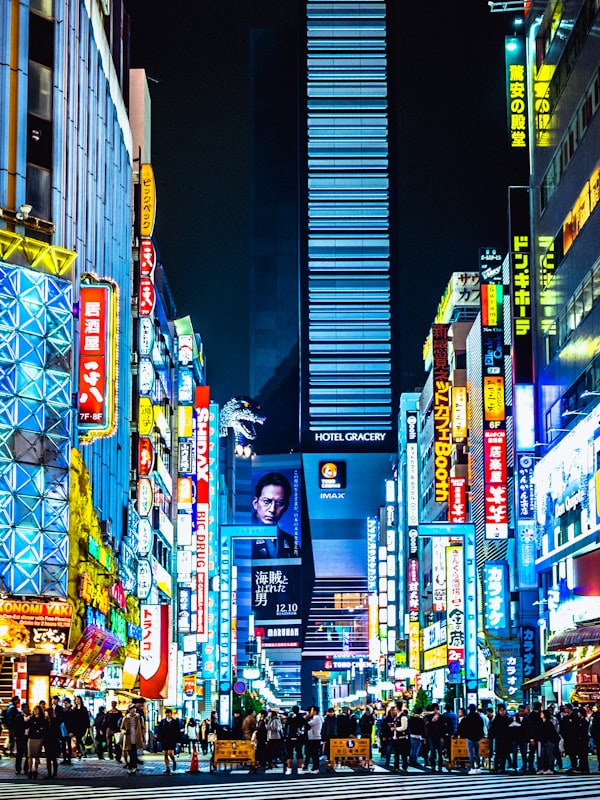
Photos: Erik Eastman, Svetlana Gumerova, Erik Eastman · Unsplash
Frequently asked questions
Do I need to speak Japanese fluently to work in Japan?
Fluency is not absolutely necessary, but it depends heavily on the type of work. In technology and finance multinationals, you can manage well with English in day-to-day professional life. Beyond that, at least business Japanese is required, and for any real long-term career growth, genuine language proficiency becomes almost indispensable. Most qualified professionals arriving from abroad spend the first months studying while working.
How does the work visa for foreigners function?
Japan uses a points system for qualified professionals, based on criteria such as educational level, experience, salary, and field of work. Sectors with urgent demand, such as technology and engineering, receive more favorable scoring. Most professionals come with sponsorship from their employer, which makes the application. There is no direct equivalent to a green card, but periodic renewals are conditional on maintaining employment and status.
Can a spouse work if I obtain a visa?
Yes, a spouse can obtain a dependent visa and work, but must request permission for paid activity with immigration. In practice, this is usually approved with relative ease, but adds some bureaucratic steps. This offers flexibility for families moving together.
What is the culture of overtime and working hours like?
Overtime culture is real and structural, especially in traditional companies. It is not uncommon to remain in the office late even with actual work already completed, something seen as a sign of commitment and loyalty. Technology sectors and startups tend to be somewhat less rigid, but change is gradual. Growing concern about the effects of overwork is pressuring companies to moderate, but the mentality that dedication is virtue still predominates.
Ready to go beyond the summary?
View the complete guide: Japan