
Country dossier · Living
🇱🇺 Luxembourg
Living guide: real net salary, cost of living, taxes, health and quality of life, with source for every figure.
- Region
- Western Europe
- Capital
- Luxembourg (city)
- Languages
- Luxembourgish, French, and German (all official)
- Currency
- Euro (EUR)
- Population
- approximately 680 thousand
- Time zone
- UTC+1 (CET)
- Blocs
- EU + Schengen (eurozone)
Luxembourg is a paradox that works. One of Europe's smallest countries, with a population equivalent to a mid-sized city, yet one of the world's richest in GDP per capita. The country thrives on the international financial sector and investments, which attract an extraordinarily diverse population: nearly half of residents were born abroad, creating an atypical cosmopolitan environment in the region. For those seeking economic stability, competitive salaries, and high quality of life, the country offers real opportunities, but brings clear challenges of linguistic integration and elevated cost of living.
Luxembourg at a glance
Languages and regions
Luxembourg is trilingual by constitution: Luxembourgish (mother tongue), French, and German are all official. In daily life, you hear all three, plus English and Portuguese in expat communities. Luxembourgers learn all three languages from childhood and expect residents to make similar effort. The region is compact: by car, you cross the country in minutes. Cross-border communities (French, Belgian, and German) are integrated into Luxembourg's labor market, with tens of thousands of people crossing the border daily for work.
Climate and geography
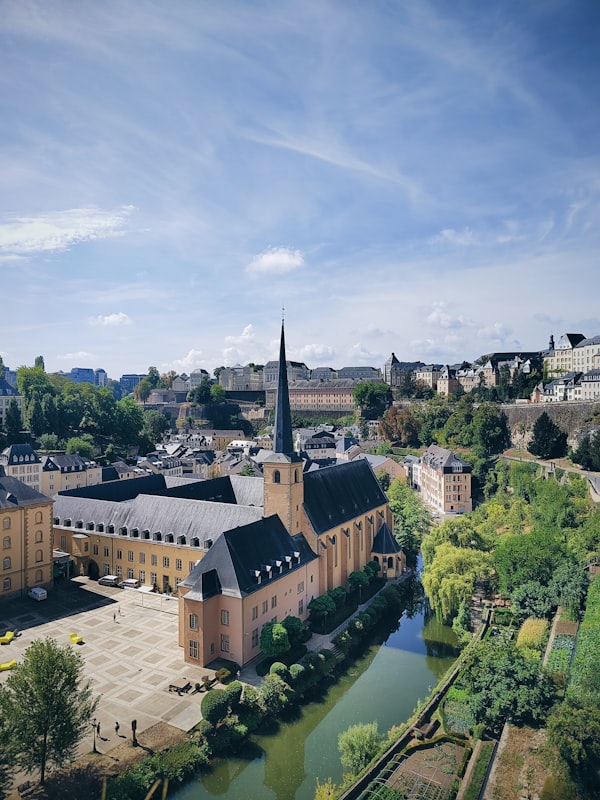
The climate is temperate oceanic, with moderate winters and mild summers. Luxembourg is neither too hot nor too cold, but quite gray in winter, typical of the Benelux. The country is predominantly forested and rural outside the capital, with valley and forest landscapes that appeal to hiking enthusiasts. The capital, Luxembourg City, is a compact urban center built in a valley, with architecture mixing medieval, Belle Époque, and modernity. Classic European urban pattern: walking is viable, public transport is excellent and well organized.
What drives the economy
Luxembourg is a pillar of the European financial system. Banks, investment funds, and pension funds dominate the economy. The country also thrives on management of legal entities, tax consulting, and e-commerce. The economy is highly internationalized, highly dependent on global capital flows. Historically low unemployment, but the labor market rewards specialization and fluency in European languages. In-demand professions include engineering, data analysis, tax law, and fund management.
Education
The education system is trilingual from the start: children learn Luxembourgish, French, and German in parallel. For those arriving from outside, this can be challenging in the early years, but there are internationally recognized quality international schools. Higher education is subsidized for Luxembourg residents, but not for foreigners. The University of Luxembourg offers education in French and English, with programs focused on research. Technical and vocational education is well structured and valued in the market. Compulsory education until age 16, and until age 18 from the 2026/2027 school year, with selection for academic or professional tracks.
Culture and integration
Cultural integration is paradoxical: Luxembourg is open to foreigners (it needs them to function), but the native community is cohesive and their languages are a real barrier. There are well-established communities of Portuguese, French, Belgian, and expats from other nationalities. Cultural events exist (jazz festival, book fairs, cinema), but social life tends to organize around work, international schools, or communities of origin. Luxembourgers are polite but reserved; deep friendships with natives require linguistic effort and time. Security is excellent, crime virtually nonexistent compared to European standards.
Fun facts
- Luxembourg is the only sovereign Grand Duchy left in the world, a rare constitutional monarchy with continuous medieval tradition dating back to the 10th century.
- The country has nearly half a foreign resident population, one of the highest rates globally, shaping a cosmopolitan society very distinct from its neighbors.
- A large portion of workers living in Luxembourg are cross-border commuters who live in France, Belgium, or Germany and cross the border daily for work.
- Luxembourg schools are among the most equitable in Europe in PISA studies, despite the extreme diversity of students' origins.
- The original Luxembourg currency (Luxembourg franc) ceased circulation in 2002, but remains national nostalgia; the Euro simplified life for those working internationally.
Net salary, summarized
Source: national medians (OECD/Eurostat) + calculator formulaJust to show the ballpark of what you earn. Tax and cost of living take a chunk. Three sample professions, junior to senior. The full calculation, for your role, level, family, and currency, is the Living calculator.
| Profession | Junior | Mid | Senior |
|---|---|---|---|
| Software developer | US$ 6.306 | US$ 7.660 | US$ 11.424 |
| Financial analyst | US$ 4.929 | US$ 6.006 | US$ 8.788 |
| Nurse | US$ 4.454 | US$ 5.434 | US$ 7.972 |
Estimated net monthly, after progressive tax, in dollars (site base). Calculate for your role, level, and currency →
Cost of living, what you actually keep
Source: basket for couple + 2 children (Numbeo) + local health and school rules| Housing (rent)≈ 42% of cost | US$ 2.394 |
| Food | US$ 1.190 |
| Transport | US$ 496 |
| Utilities and internet | US$ 430 |
| Recreation and other | US$ 1.190 |
| Healthcare | US$ 30 |
| Children's schoolpublic viable for non-residents | included |
| Total cost per month | US$ 5.730 |
Spending pattern (housing + living only)
Local tax, health, and school rules change how much is left at month end.
Family and immigration
Visa and spouse work rules; local values estimatedQuality of life
Indices: GPI, PISA, WHO, WHR, Ookla, EF EPI, CPI (0 to 10)Life
Daily
Institutions
Verdict
Luxembourg is pragmatic: it offers excellent prospects for professionals with specialized skills valued internationally, fluency in European languages, and willingness to pay a premium for quality of life and security. High salaries compensate for cost of living, but it is not a low-cost economy. The financial sector dependence is a structural risk. Society is efficient and secure, but social integration is slow. Recommended for professionals in career growth, families prioritizing international education, and couples without local roots. Less suitable for retirees seeking simplified financial longevity.
Complete guide: Luxembourg
This page is the sample. The guide is the complete map.
Everything you saw here, deeper and actionable: from first visa step to moving day, sourced for every fact.
- Visa and sponsorship, step by step
- Cities and regions compared
- Health insurance: how to choose
- Retirement, taxes, and local rules
- Useful links: housing, bank, jobs
Imagine yourself here.
Photos: Alena Praslova, Manu, Maurice Sahl · Unsplash
Frequently asked questions
How is the work visa for those who are not European Union citizens?
Those who are not EU citizens need a visa and a work authorization. The employer must prove that no European citizen fills the position, which makes the process selective. Highly specialized professionals (engineering, finance, IT, sciences) can gain permission, but it is a long and costly process. There is also a residence visa for investors and entrepreneurs. Spouses of Europeans have automatic right of residence. International students can work an average of up to fifteen hours per week during the academic semester.
Can my spouse or partner work if I get a visa?
If you are an EU citizen or hold a valid European residence visa, your spouse or registered partner has the right of free movement within the EU by association. This means they can work in Luxembourg without a separate visa. If you are not an EU citizen and obtain a work visa, your spouse's right is more restricted: they will also need a work visa or dependent residence visa. Many couples resolve this situation with one spouse being European or both seeking professional placement independently.
How much does it cost to live in Luxembourg? Does the salary compensate?
Luxembourg is among the most expensive countries in Europe, but with salaries ranking among the highest on the continent. Apartment rental in the center is high, food is above European average, transportation is excellent but not free. Professionals in the financial sector, engineering, and IT achieve substantial salaries that cover cost of living with ease. Taxes are progressive. Those working remotely for a company abroad would need to negotiate in strong currency. The real balance depends on professional sector, not on the general desire for low cost.
Is it easy to learn the languages? Can I live on English alone?
Luxembourg is multilingual, and English functions professionally and in urban contexts. Socially, however, you will be isolated without French and without effort in Luxembourgish. French opens doors: it is the language of business, public administration, and schools. Luxembourgish marks local identity. Language schools exist, but real learning takes time. Many expats manage to live functionally in English and French, but local friendships and real integration require more effort. Children learn trilingually naturally in international and public schools.
Ready to go beyond the summary?
View the complete guide: Luxembourg