
Country dossier · Living
🇲🇾 Malaysia
Living guide: real net salary, cost of living, taxes, health and quality of life, with source for every figure.
- Region
- Southeast Asia
- Capital
- Kuala Lumpur
- Languages
- Malay (official), English widely used, also Mandarin and Tamil
- Currency
- Malaysian Ringgit (MYR)
- Population
- ≈ 34 million
- Time zone
- UTC+8
- Blocs
- ASEAN
Malaysia is a balancing point in Southeast Asia: solid infrastructure of a middle-high income country, considerably lower cost of living than neighboring Singapore, and a genuinely multiethnic society where Malays, Chinese, Indians, and foreign communities coexist. Those who arrive encounter a modern economy based on manufacturing, technology, oil and gas, and tourism, a regional business hub and home to multinational corporations, and a quality of life that attracts both remote professionals and retirees looking to stretch a budget. Cultural diversity is not a slogan, it is living architecture of food, languages, and celebrations that reflect three or more worlds in a single city.
Malaysia at a glance
Languages and regions
Malay is the official language, but English is widely spoken and functions as the business language in multinational companies and startup hubs in Kuala Lumpur. You will move comfortably in English in corporate spaces, universities, and among foreigners, but learning Malay opens doors to everyday life and community integration. Malaysia is triethnic in structure: the Malay Muslim population forms the demographic majority, while the Sino-Malaysian community frequently speaks Mandarin, Cantonese, or Hokkien at home and with family, and the Indo-Malaysian community preserves Tamil and other languages from the subcontinent. Kuala Lumpur concentrates all this diversity in superlative form: it is the largest city, cosmopolitan, with infrastructure of a major metropolis, while cities like Penang (in the north) and Johor Bahru (south) offer alternatives with even lower costs and their own cultural dynamics. The country's geography spans the Malay Peninsula and the states of Sabah and Sarawak in Borneo, each region with distinct demographic and economic nuances.
Climate and geography
Malaysia sits in the equatorial tropics: hot and humid climate year-round, with no well-defined seasons. Temperature fluctuates around 25 to 32 degrees Celsius for most of the year, with high relative humidity that characterizes Southeast Asia. During monsoon periods (between October and March on the Peninsula, and between September and March in Sabah) rainfall increases, but life goes on normally with a population adapted for centuries. Geographically, Malaysia occupies a strategic position: the Malay Peninsula sits between Thailand to the north and Singapore to the south, while the island regions of Sabah and Sarawak occupy the northern portion of the island of Borneo. The topography includes coastal plains and interior mountain ranges, with tropical forest covering a vast portion of the territory. This geography gives the country exceptional biodiversity and varied landscapes, from urban coastline to wild interior.
What the country lives on
Malaysia's economy is diversified and based on semiconductor and electronics manufacturing, oil and natural gas refining (Petronas is one of the region's largest oil companies), regional tourism, financial services, and increasingly in technology and startups. Kuala Lumpur functions as a business hub for Southeast Asia, attracting regional headquarters of multinational companies. The agricultural sector remains important, including palm oil, rubber, and cocoa production, although it does not dominate GDP. The ringgit is convertible and there is an expanding middle class consuming services and imports. The labor market for foreigners is competitive in areas such as technology, engineering, corporate management, and education, where demand for international talent is real. The operational cost of a modest living is clearly lower than in developed countries or in Singapore itself, while infrastructure quality and services remain reasonable.
Education
Malaysia's educational system was inherited and still reflects the British structure introduced during the colonial period. Primary and secondary education follows this model, with standardized national exams (SPM at the end of high school). Public and private universities offer undergraduate and postgraduate courses in various fields, with some respected regionally, such as the University of Malaya and Universiti Kebangsaan Malaysia. Kuala Lumpur is home to several international universities, such as branch campuses of British and Australian universities, and recognized international schools. This segment of international education is larger and more expensive, attended by children of expats and wealthy local families. For foreign children, there are options for international schools following British, American, or other curricula, with significant cost but recognized quality. Private higher education is affordable compared to Western standards.
Culture and integration
Malaysia is a laboratory of genuine multiculturalism, not stereotyped. Muslim Malays, Chinese, Indians, and smaller communities such as aboriginal Orang Asli share the same territory for centuries, each maintaining their own traditions, religions, and festivities. You will see mosques, Chinese temples, Hindu temples, and Christian churches in the same city, frequently within a few kilometers of each other. Holidays like Hari Raya (Muslim Eid), Chinese New Year, Deepavali (Hindu), and Christmas are national holidays and celebrated publicly, with non-Muslim communities having holidays for their festivities as well. Gastronomy reflects this plurality: Malay nasi lemak, Chinese dim sum, Indian roti canai, multiethnic laksa, all coexist on the streets. Foreigners are generally welcome, especially in Kuala Lumpur, where expatriate communities have been established for decades and offer support networks. There are expatriate social groups, international coworkings, and community spaces where you find other foreigners. Integration with locals requires effort, as anywhere, but the environment is more cosmopolitan than in many countries in the region.
Fun facts
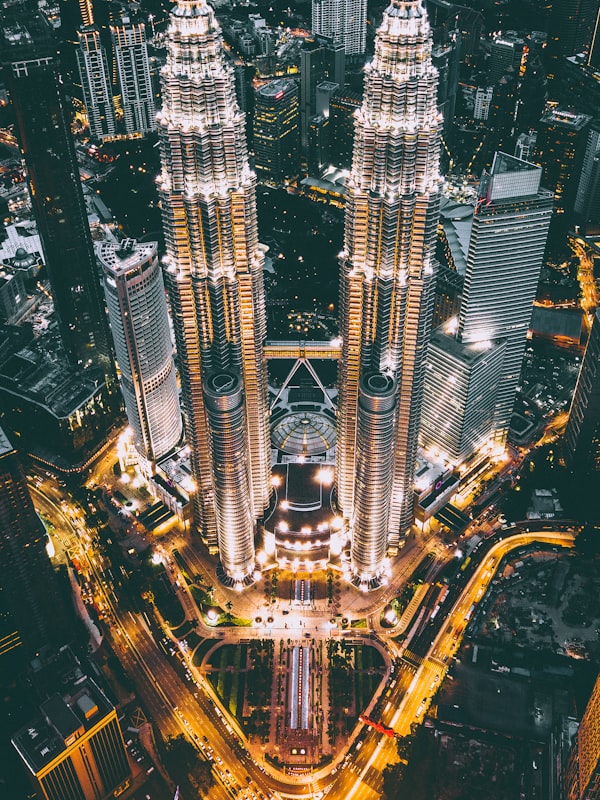
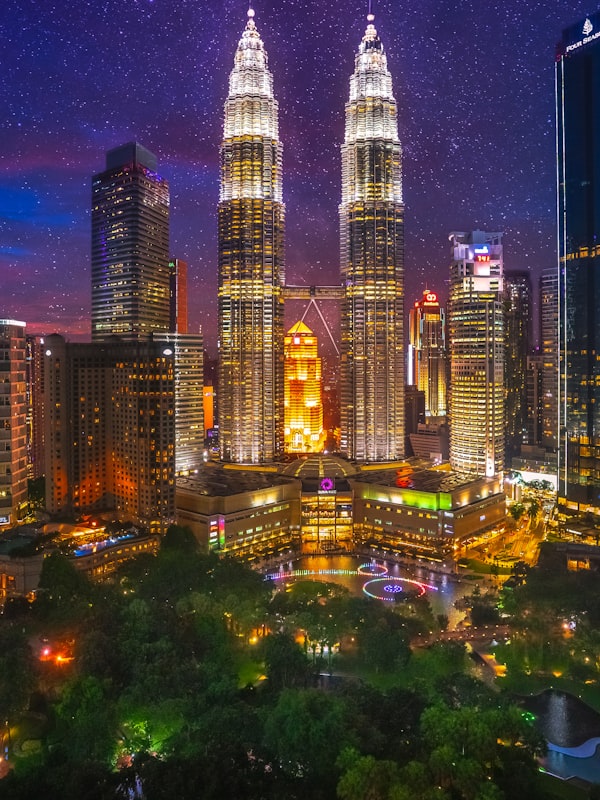
- The Petronas Towers, twin and futuristic, were the world's tallest building from 1998 to 2004 and remain an architectural icon of Malaysia, visible from much of Kuala Lumpur and a symbol of the country's modernist ambition.
- Malaysia is one of the world's largest palm oil producers, responsible for approximately one-third of global production, a sector that generates income but is also a focus of international environmental criticism.
- Kuala Lumpur ranks among the most affordable cities in Southeast Asia in terms of cost of living, rivaling Bangkok and Chiang Mai, while maintaining infrastructure and services close to Singapore standards.
- The country is home to Taman Negara forest, a protected natural heritage site around 130 million years old, one of the planet's oldest continuous ecosystems.
- Malaysia became independent from the United Kingdom in 1957, and Singapore was part of the Malaysian federation between 1963 and 1965, when it separated, an event that shaped regional history, economy, and politics to this day.
Net salary, summarized
Source: national medians (OECD/Eurostat) + calculator formulaJust to show the ballpark of what you earn. Tax and cost of living take a chunk. Three sample professions, junior to senior. The full calculation, for your role, level, family, and currency, is the Living calculator.
| Profession | Junior | Mid | Senior |
|---|---|---|---|
| Software developer | US$ 1.297 | US$ 1.606 | US$ 2.435 |
| Financial analyst | US$ 993 | US$ 1.230 | US$ 1.869 |
| Nurse | US$ 890 | US$ 1.103 | US$ 1.678 |
Estimated net monthly, after progressive tax, in dollars (site base). Calculate for your role, level, and currency →
Cost of living, what you actually keep
Source: basket for couple + 2 children (Numbeo) + local health and school rules| Housing (rent)≈ 32% of cost | US$ 736 |
| Food | US$ 563 |
| Transport | US$ 235 |
| Utilities and internet | US$ 203 |
| Recreation and other | US$ 563 |
| Healthcare | US$ 30 |
| Children's school | US$ 1.333 |
| Total cost per month | US$ 3.663 |
Spending pattern (housing + living only)
Local tax, health, and school rules change how much is left at month end.
Family and immigration
Visa and spouse work rules; local values estimatedQuality of life
Indices: GPI, PISA, WHO, WHR, Ookla, EF EPI, CPI (0 to 10)Life
Daily
Institutions
Verdict
Malaysia is a solid choice for those seeking lower cost of living while maintaining corporate infrastructure and urban comfort, combining genuine cultural diversity, tropical climate, and a labor market open to international talent in specific sectors. As a counterpoint, the hot and humid climate year-round does not please everyone, bureaucracy can be slow in some administrative processes, and there are underlying tensions related to minority rights and religious issues that, while not affecting the daily life of most foreigners, reflect local political realities. For remote professionals or retirees with income in strong currency, the proposition is particularly attractive; for those dependent on local salary, competition is higher, but opportunities exist in technology and management.
Complete guide: Malaysia
This page is the sample. The guide is the complete map.
Everything you saw here, deeper and actionable: from first visa step to moving day, sourced for every fact.
- Visa and sponsorship, step by step
- Cities and regions compared
- Health insurance: how to choose
- Retirement, taxes, and local rules
- Useful links: housing, bank, jobs
Imagine yourself here.
Photos: Izuddin Helmi Adnan, Izuddin Helmi Adnan · Unsplash
Frequently asked questions
What is the work visa process for foreigners in Malaysia?
Malaysia offers work visas for foreign professionals, generally sponsored by an employer. The process involves a formal application from the company, approval from the Ministry of Human Resources, and issuance of an Employment Pass valid for up to two years. High-demand sectors such as technology, engineering, and management tend to have faster approvals. Malaysia also has the Malaysia My Second Home (MM2H) program, a long-term visa for retirees, investors, and remote professionals who meet income and bank deposit criteria, offering extended stay without requirement for local work.
Can my spouse or partner work if I get a job in Malaysia?
Yes, spouses of Employment Pass holders can apply for a Dependent Pass visa and, in many cases, obtain associated work rights, although with some variation according to current employer and government policies. Practice may vary between companies, so it is recommended to confirm with the potential employer during negotiations. Unmarried partners face greater restrictions, as the system mainly recognizes spouses and children as eligible dependents.
What is the approximate cost of rent and everyday living in Kuala Lumpur?
The cost of living in Kuala Lumpur is significantly lower than in cities like Singapore, Hong Kong, or European capitals. A two-bedroom apartment in the center can be rented in a moderate range, while residential areas further away offer even more savings. Food is cheap if you frequent local restaurants and markets, while international supermarkets and expat neighborhoods tend to be more expensive. Public transportation via metro (LRT/MRT) is economical, as are taxis and ride-sharing. Quality of life is considered good for the price, which explains why the city attracts remote professionals and retirees looking to stretch a budget.
Is it necessary to learn Malay to live in Malaysia?
It is not essential, especially if you live in Kuala Lumpur and work in corporate environments where English predominates. However, learning the language opens significant doors to social integration, understanding local contexts, navigating administrative processes, and building friendships with neighbors and communities. Malay is a relatively accessible language for Portuguese speakers (both are Indo-European languages with similar structures in some aspects), and with a few months of casual study you can function in everyday situations. Expatriate communities offer classes, and there is an abundance of online resources.
Ready to go beyond the summary?
View the complete guide: Malaysia