
Country dossier · Living
🇳🇴 Norway
Living guide: real net salary, cost of living, taxes, health and quality of life, with source for every figure.
- Region
- Northern Europe (Scandinavia)
- Capital
- Oslo
- Languages
- Norwegian, English widely spoken
- Currency
- Norwegian Krone (NOK)
- Population
- ≈ 5.6 million
- Time zone
- UTC+1 (CET)
- Blocs
- Outside the EU (EEA + EFTA), Schengen
Norway is Europe's most expensive country to live in, period. Cost of living is among the highest in Europe, ahead even of Switzerland in several items, and salaries, though good, don't go as far as they seem. Wealth comes from oil, which funds impressive welfare state: health, education and pension are very strong. Worth it if you get income above the 75th percentile locally, otherwise it's tight.
Norway at a glance
Languages and regions
Norwegian is the official language, but English is very widely spoken, especially among young people and in big cities like Oslo, Bergen and Trondheim, with penetration comparable to Denmark's, and it's enough in the work environment of multinationals. The country is long and mountainous, with a spectacular fjord coastline, and the climate varies a lot between the arctic north and the temperate south, with large distances within the country.
Climate and geography
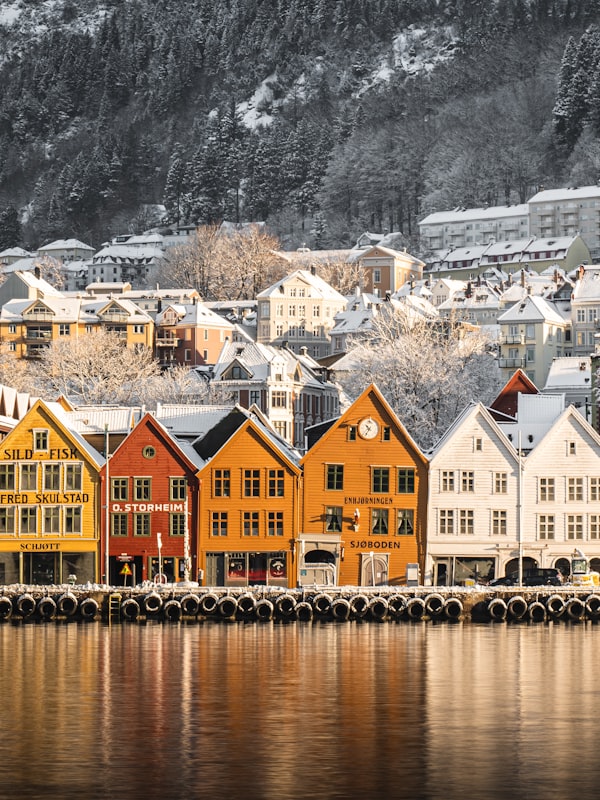
The territory is narrow and long, on the western flank of Scandinavia, bordered by the Atlantic Ocean, and the climate varies a lot: the south is temperate oceanic, with mild winters, and the north is arctic. Fjords, mountains and lakes dominate the landscape, and above the Arctic Circle summer brings 24 hours of daylight, just as winter brings near-permanent night, when the northern lights become a real phenomenon to witness. The landscape is wild, but traveling within the country is expensive.
What the country lives on
Mineral wealth comes from oil and natural gas in the North Sea, which fund the world's richest sovereign wealth fund. Beyond energy, the country lives on fishing, the aluminum industry, technology and tourism, with a prosperous, competitive economy whose cost of living reflects high local salaries. Taxation is progressive, and the welfare state is generously funded.
Education
Public education is free and high quality, from childcare through university, and the system values vocational training as much as the university path, similar to Denmark and Sweden. Universities have a strong research focus, childcare is subsidized and widely available, and the system as a whole is inclusive and not very competitive until the end.
Culture and integration
Norwegian culture values equality, privacy, nature and outdoor life, with hiking and skiing part of the national identity. Work is professional but not very hierarchical, and society is formally egalitarian but socially reserved: it's easy to make friends at work, but harder to integrate into already-established social circles. Immigration policy has become more restrictive in recent years.
Fun facts
- Norway has the world's richest sovereign wealth fund, fed by oil revenue and managed with a conservative withdrawal policy, of 3% a year since 2017, when the ceiling was lowered from 4%.
- Not an EU member, but participates in the EEA (European Economic Area), having adopted much of EU legislation.
- Skiing is a national sport, and winter infrastructure is impressive, with slopes, night-skiing lighting and dedicated ski villages.
- Norwegian salmon is a global product, and the country's leadership in aquaculture is irrefutable.
- Immigration policy is a topic of constant public debate, with a trend toward more restrictions and explicit integration requirements.
Net salary, summarized
Source: national medians (OECD/Eurostat) + calculator formulaJust to show the ballpark of what you earn. Tax and cost of living take a chunk. Three sample professions, junior to senior. The full calculation, for your role, level, family, and currency, is the Living calculator.
| Profession | Junior | Mid | Senior |
|---|---|---|---|
| Software developer | US$ 5.174 | US$ 6.275 | US$ 9.176 |
| Financial analyst | US$ 4.051 | US$ 4.929 | US$ 7.189 |
| Nurse | US$ 3.663 | US$ 4.463 | US$ 6.528 |
Estimated net monthly, after progressive tax, in dollars (site base). Calculate for your role, level, and currency →
Cost of living, what you actually keep
Source: basket for couple + 2 children (Numbeo) + local health and school rules| Housing (rent)≈ 38% of cost | US$ 1.862 |
| Food | US$ 1.094 |
| Transport | US$ 456 |
| Utilities and internet | US$ 395 |
| Recreation and other | US$ 1.094 |
| Healthcare | included |
| Children's schoolpublic viable for non-residents | included |
| Total cost per month | US$ 4.900 |
Spending pattern (housing + living only)
Local tax, health, and school rules change how much is left at month end.
Family and immigration
Visa and spouse work rules; local values estimatedQuality of life
Indices: GPI, PISA, WHO, WHR, Ookla, EF EPI, CPI (0 to 10)Life
Daily
Institutions
Verdict
Worth it for well-paid professionals in technology, energy, health or specialized sectors who get employer sponsorship. Cost of living is so high that Norwegian salary, even if it looks good, is quickly eroded by rent and consumption. Worth less for those starting career: the balance between income and expenses is negative until you advance considerably. Point of caution: immigration policy is restrictive outside EU/EEA, integration requirements and language are explicit, and community can be closed for those who don't integrate quickly.
Complete guide: Norway
This page is the sample. The guide is the complete map.
Everything you saw here, deeper and actionable: from first visa step to moving day, sourced for every fact.
- Visa and sponsorship, step by step
- Cities and regions compared
- Health insurance: how to choose
- Retirement, taxes, and local rules
- Useful links: housing, bank, jobs
Imagine yourself here.
Photos: Patrik Kovar, ZHANG Shaoqi, Benjamin Blyth · Unsplash
Frequently asked questions
Do I need to speak Norwegian to work in Norway?
In international companies and tech in Oslo, no: English is enough. Outside that world, Norwegian carries more weight in hiring and integration, and official policy requires learning the language as part of the integration process, with courses offered, some of them free.
How does work immigration work?
A work visa requires employer sponsorship, and is only issued if no Norwegian or EEA candidate is available for the position. Permanent residency usually requires 3 years of continuous legal residence, and 5 years for those on a permit based on protection or asylum, and access is easier for EEA citizens.
What's the real cost of housing?
In Oslo, rent for a one-bedroom apartment downtown runs NOK 15,000 to 20,000 a month, around EUR 1,400 to 1,900, and outside the capital the price drops, though it's still expensive compared to most of Europe. Buying property is also very expensive.
Does the welfare state work for immigrants?
Legal residents have access to health, education and social benefits, though pension requires prior contributions. Benefits are robust, but full access depends on residency status, temporary or permanent, and how long you've already lived in the country.
Ready to go beyond the summary?
View the complete guide: Norway