
Country dossier · Living
🇸🇬 Singapore
Living guide: real net salary, cost of living, taxes, health and quality of life, with source for every figure.
- Region
- Southeast Asia
- Capital
- Singapore (city-state)
- Languages
- English, Mandarin, Malay, and Tamil (4 official)
- Currency
- Singapore Dollar (SGD)
- Population
- ≈ 6.1 million
- Time zone
- UTC+8
- Blocs
- Outside formal regional blocs; member of ASEAN
Singapore is a paradox: it offers low personal income taxes, impeccable infrastructure, and an economy among the most developed in the world. But the city charges dearly for this, with housing costs that rival Zurich and Geneva and quickly consume the tax advantage. It's a destination that seduces through efficiency and opportunity, but demands precise calculations before the move.
Singapore at a glance
Languages and regions
Singapore is officially multilingual: English, Mandarin, Malay, and Tamil coexist with equal constitutional status. In practice, English dominates the professional environment and younger generations, functioning as a lingua franca in a society where nearly everyone speaks a second language at home. Anyone relocating to work in technology, finance, or engineering can operate well with English alone, without immediate pressure to learn Mandarin or Malay. Still, some Mandarin phrases help in business and social integration.
Climate and geography
Singapore is a small equatorial island, with high temperature and humidity year-round, around 30 degrees, without defined seasons. Two monsoon seasons bring heavy but brief rainfall. The tiny geography, roughly 730 square kilometers, makes any point in the city just minutes away by metro from another. For those escaping freezing winters, it's immediate refuge; for those who like marked seasons or prefer dry heat, it requires adaptation.
What the country lives on
Singapore's economy rests on three pillars: international finance, with the port and currency making it an Asian hub for foreign exchange and derivatives, port logistics, home to one of the world's largest ports by container throughput, and growing technology, with startups and multinationals attracted by connectivity and available qualified talent. There is no room for heavy industry or relevant agriculture: almost everything is imported or gains added value locally.
Education
Singapore's public education system is internationally recognized for results in mathematics and sciences, with competitive schools and explicit meritocracy from an early age. Public universities like NUS and NTU rank among Asia's best in international rankings. Education is not free for foreigners at all levels, but quality usually justifies the investment. National exams are rigorous, and academic pressure on children is notable compared with many Western countries.
Culture and integration
Singapore is a multiethnic society where Chinese, Malays, Indians, and foreigners coexist under well-defined rules: rigorous urban cleanliness, restrictions on spitting in public, nighttime silence, severe penalties for vandalism. This order creates an immaculate, safe, and predictable city, but demands behavioral conformity that may sound rigid to those from more informal cultures. Integration is possible, especially for qualified foreign professionals, but friendships tend to organize around ethnic or professional circles.
Fun facts
- Singapore has no permanent standing army in the traditional sense; every male completes about two years of mandatory military service.
- Singapore's port ranks among the world's busiest, with ships arriving in practically continuous flow.
- Fines for not flushing the toilet in a public bathroom or for spitting in the street can reach hundreds of dollars, reflecting local obsession with cleanliness.
- The metro (MRT) is so efficient that taxis and ride-sharing apps are relatively rarely used for daily commuting.
- There is an extensive underground section connecting shopping malls, restaurants, and parking with permanent air conditioning in the city center.
Net salary, summarized
Source: national medians (OECD/Eurostat) + calculator formulaJust to show the ballpark of what you earn. Tax and cost of living take a chunk. Three sample professions, junior to senior. The full calculation, for your role, level, family, and currency, is the Living calculator.
| Profession | Junior | Mid | Senior |
|---|---|---|---|
| Software developer | US$ 5.993 | US$ 7.424 | US$ 11.277 |
| Financial analyst | US$ 4.584 | US$ 5.682 | US$ 8.647 |
| Nurse | US$ 4.109 | US$ 5.095 | US$ 7.759 |
Estimated net monthly, after progressive tax, in dollars (site base). Calculate for your role, level, and currency →
Cost of living, what you actually keep
Source: basket for couple + 2 children (Numbeo) + local health and school rules| Housing (rent)≈ 45% of cost | US$ 2.745 |
| Food | US$ 1.208 |
| Transport | US$ 503 |
| Utilities and internet | US$ 436 |
| Recreation and other | US$ 1.208 |
| Healthcare (private plan required)fixed cost, does not decrease with lower income | US$ 250 |
| Children's school | US$ 4.167 |
| Total cost per month | US$ 10.517 |
Spending pattern (housing + living only)
Local tax, health, and school rules change how much is left at month end.
Family and immigration
Visa and spouse work rules; local values estimatedQuality of life
Indices: GPI, PISA, WHO, WHR, Ookla, EF EPI, CPI (0 to 10)Life
Daily
Institutions
Verdict
It's worth living in Singapore for anyone working in technology, finance, engineering, or healthcare at senior or full levels, where gross salary and favorable tax burden leave real surplus after paying for housing and living expenses. It's worth less for those early in their careers: rent here has one of the worst cost-to-salary ratios in the world, consuming a significant portion of early-career earnings. Integration is possible, especially in international professional circles, but requires willingness to adapt to rigid social rules and constant tropical climate. Real point of concern: the work visa is employer-linked, so leaving a job puts migration status at immediate risk, requiring careful planning in any career change.
Complete guide: Singapore
This page is the sample. The guide is the complete map.
Everything you saw here, deeper and actionable: from first visa step to moving day, sourced for every fact.
- Visa and sponsorship, step by step
- Cities and regions compared
- Health insurance: how to choose
- Retirement, taxes, and local rules
- Useful links: housing, bank, jobs
Imagine yourself here.
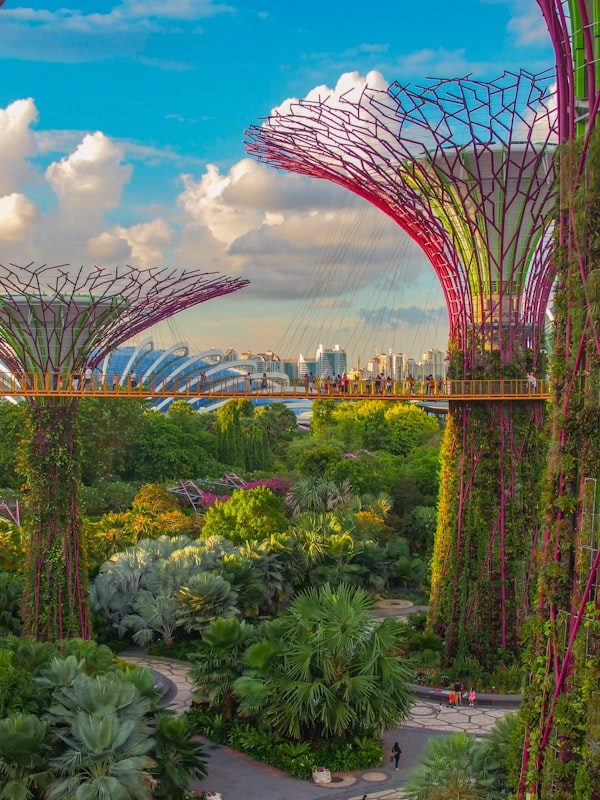
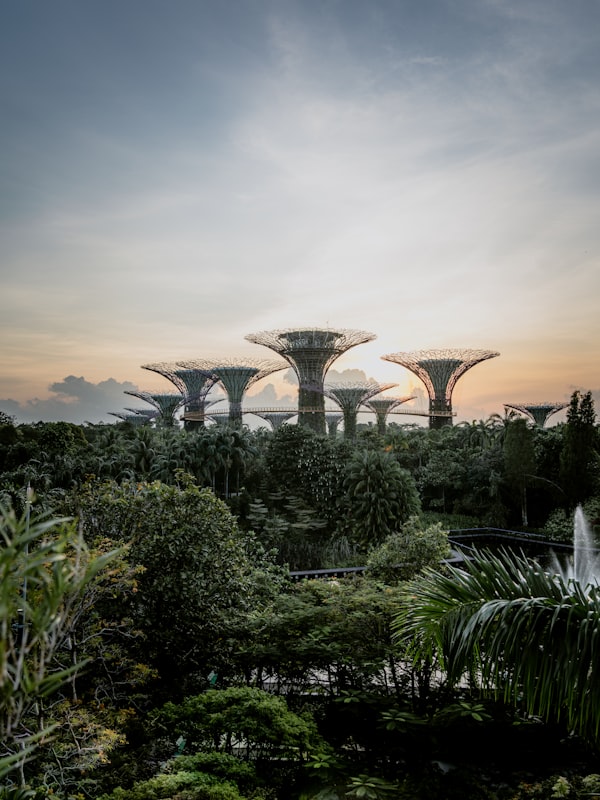
Photos: Coleen Rivas, isaac., isaac. · Unsplash
Frequently asked questions
Do I need to speak Mandarin or Malay to work in Singapore?
No. English is sufficient and predominant in any professional environment, from startups to multinational banks. Younger generations almost always converse in English. Learning basic Mandarin phrases helps with social integration and in business, especially with local clients, but it's not mandatory to live or work.
How does the work visa in Singapore work?
Singapore uses two main categories: a work visa tied directly to employer sponsorship, with salary requirements varying by level, and a points system for high-potential professionals. The employer must sponsor the visa, so you can't relocate and job hunt on your own. Once hired, the visa is tied to the company, and changing jobs requires a new application.
Can my spouse work if I have a work visa in Singapore?
Yes, but they don't have an automatic right to work. They need to receive a job offer and go through the same work visa process. There are specific categories for dependents that facilitate spouse entry, but work itself requires separate documentation and approval from an employer. Children can attend international or public schools without a separate visa while accompanying the visa holder.
Why is rent in Singapore so expensive?
Because land is scarce, roughly 730 square kilometers for more than 6 million people, urban planning is rigorous, and demand from well-paid foreign professionals exceeds housing supply. Most Singaporeans live in public HDB blocks, with subsidies and more accessible costs. The private rental market, where foreigners usually rent, operates as a high-standard market. A bedroom in an apartment in a central area can easily consume half the monthly budget of an early-career professional.
Ready to go beyond the summary?
View the complete guide: Singapore