
Country dossier · Living
🇹🇭 Thailand
Living guide: real net salary, cost of living, taxes, health and quality of life, with source for every figure.
- Region
- Southeast Asia
- Capital
- Bangkok
- Languages
- Thai
- Currency
- Thai Baht (THB)
- Population
- ≈ 71 million
- Time zone
- UTC+7
- Blocs
- ASEAN
Thailand is an established destination for digital nomads, foreign retirees, and people seeking low cost of living, for decades now. Bangkok and Chiang Mai concentrate most foreigners, with established communities and infrastructure geared toward this audience. The cost of living is indeed among the most accessible in the world, especially outside tourist-oriented neighborhoods. Local salaries are modest, but those working remotely in strong currency or with international fixed income find significant purchasing power. The economy operates primarily around tourism, manufacturing, and services, with a significant portion of the population working in sectors related to international tourism.
Thailand at a glance
Languages and regions
Thai is the official language, but Bangkok and tourist regions have very strong presence of English speakers, especially among merchants, hoteliers, and professionals. Chiang Mai, in the north, is historically the second hub of attraction for foreigners and offers even lower cost of living. The north has distinct culture, influenced by Lanna traditions and mountainous landscape. The south is dominated by islands and beaches. The Northeast region, known as Isan, is more rural and less integrated into the tourism economy. Bangkok remains the economic and administrative heart of the country, where opportunities and international services concentrate.
Climate and geography
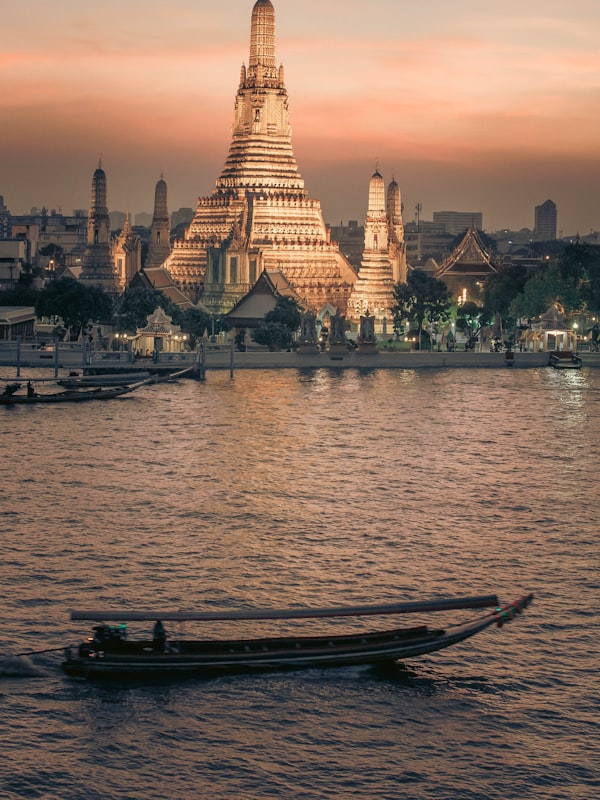
The climate is tropical year-round, hot and humid, with temperatures rarely below 20°C. The rainy season, from May to October, is marked by intense precipitation especially in the afternoon, but predictable and with urban life functioning normally. The dry season, from November to April, is considered ideal for living, with milder climate, especially in December and January. The country is predominantly flat in the center and northeast, with mountains in the north. The Chao Phraya River is essential to Bangkok and its region, functioning as an axis of transport and daily life. Being prepared for intense heat and humidity is important for those living there.
What the country lives from
Thailand is a middle-to-high income economy, heavily dependent on international tourism, which represents a significant portion of GDP. Manufacturing is relevant, with highlights in automotive, electronics, and textiles. Agriculture, especially rice production, still employs a significant portion of the population, mainly in rural regions. Services grow, including financial sectors and technology outsourcing. The economy faces structural challenges of regional inequality and dependence on exports. For foreigners, remote work is viable and common, but local work requires appropriate visa and authority approval.
Education
The Thai education system follows traditional structure, with free public schools, but of variable quality according to region. International schools exist in Bangkok and Chiang Mai, offering British, American, or Thai-adapted curricula, with costs significantly lower than in developed countries. Higher education is offered by universities, many with programs in English, especially in major cities. Computing, engineering, and business are strong areas. Costs of private and international education are moderate compared to international standards, but still represent relevant expense for foreign families. Language of instruction is predominantly Thai in public education.
Culture and integration
Buddhism is the predominant religion and central to daily life, reflecting in respect for the king, the royal family, and the monastic order. Festivals such as Songkran (Thai New Year) and Loy Krathong are vibrant celebrations involving the entire community. Street culture is very strong, with intense neighborhood life, local markets, and street food as an essential part of urban existence. Social integration for foreigners is facilitated by the openness of the expatriate community and Thai hospitality, but deeper integration requires learning Thai and understanding cultural nuances. Hierarchy and respect are deep cultural values that affect social and professional interactions.
Fun facts
- Bangkok is one of the world's most visited cities and maintains a system of canals, the khlongs, parallel to the urban grid, which still functions as transport and market in many areas of the city.
- Thailand was never colonized by Western powers, being the only Southeast Asian nation to maintain independence during the European colonial period.
- Chiang Mai is home to more than 300 Buddhist temples, making it an important spiritual and cultural center, as well as the preferred base for many digital nomads due to its even lower cost of living.
- The country has a deep tradition of Muay Thai, Thai martial arts that are central to cultural identity, with established training tourism in specialized academies.
- The Thai Baht is a relatively stable currency for decades, offering economic security for savers in local currency and exchange rate predictability that benefits residents.
Net salary, summarized
Source: national medians (OECD/Eurostat) + calculator formulaJust to show the ballpark of what you earn. Tax and cost of living take a chunk. Three sample professions, junior to senior. The full calculation, for your role, level, family, and currency, is the Living calculator.
| Profession | Junior | Mid | Senior |
|---|---|---|---|
| Software developer | US$ 937 | US$ 1.162 | US$ 1.769 |
| Financial analyst | US$ 716 | US$ 888 | US$ 1.354 |
| Nurse | US$ 642 | US$ 796 | US$ 1.215 |
Estimated net monthly, after progressive tax, in dollars (site base). Calculate for your role, level, and currency →
Cost of living, what you actually keep
Source: basket for couple + 2 children (Numbeo) + local health and school rules| Housing (rent)≈ 33% of cost | US$ 792 |
| Food | US$ 579 |
| Transport | US$ 241 |
| Utilities and internet | US$ 209 |
| Recreation and other | US$ 579 |
| Healthcare | US$ 30 |
| Children's school | US$ 2.000 |
| Total cost per month | US$ 4.430 |
Spending pattern (housing + living only)
Local tax, health, and school rules change how much is left at month end.
Family and immigration
Visa and spouse work rules; local values estimatedQuality of life
Indices: GPI, PISA, WHO, WHR, Ookla, EF EPI, CPI (0 to 10)Life
Daily
Institutions
Verdict
Thailand is an established and well-set destination for foreigners, with infrastructure, expatriate communities, and services geared toward this audience. The favorable cost of living is real for those able to work in strong currency or with international fixed income. Challenges include intense tropical climate that is not for everyone, complexity of the visa system that changes frequently, language barrier for deeper professional integration, and public health issues that still have deficiencies compared to developed countries. Quality of life is good if you appreciate tropical environment, functional urban infrastructure, and vibrant local culture, but requires adjustment for those coming from temperate climate or a much more robust healthcare system.
Complete guide: Thailand
This page is the sample. The guide is the complete map.
Everything you saw here, deeper and actionable: from first visa step to moving day, sourced for every fact.
- Visa and sponsorship, step by step
- Cities and regions compared
- Health insurance: how to choose
- Retirement, taxes, and local rules
- Useful links: housing, bank, jobs
Imagine yourself here.
Photos: Kamil Pietrzak, Alejandro Cartagena 🇲🇽🏳🌈 · Unsplash
Frequently asked questions
What is the most common visa for foreigners who want to live in Thailand long-term?
The tourist visa obtained on arrival is the simplest entry, valid for short period. For prolonged stay, nomads and retirees typically seek the Non-Immigrant Visa (obtained outside the country), eligibility for Thai Elite Visa (private residence program) or pensioner visa according to specific income criteria. Work visas require sponsorship from a Thai local employer. Regulations change frequently, it is recommended to consult the Thai embassy for updated details.
Can my spouse or partner work legally in Thailand?
Only with appropriate work visa, which requires sponsorship from a Thai employer and compliance with strict criteria, including preference for hiring Thai citizens. The practice is quite restrictive in reality. For couples, typically only one has a work visa while the other works remotely for a company from their country of origin, maintaining a non-immigrant visa or similar.
What is the healthcare system like in Thailand?
There is a universal public system, but with quality varying according to location. The private sector is robust, with modern international-class hospitals in Bangkok and Chiang Mai, offering diagnostic and surgical services with costs significantly lower than developed countries. Many foreigners use private healthcare and purchase complementary international insurance. Medications are accessible and widely available.
What is the cost of living for foreigners in Thailand?
It is among the lowest in the world for comfortable living standards. Housing, food, transport, and entertainment cost a fraction of what they do in developed countries. Bangkok offers more variety of prices and amenities, while Chiang Mai allows lower spending while maintaining quality of life. Purchasing power for those earning in strong currency is considerable, allowing much more comfortable lifestyle than in countries of origin.
Ready to go beyond the summary?
View the complete guide: Thailand