
Country dossier · Living
🇦🇺 Australia
Points based immigration and warm weather, with housing costly in Sydney and Melbourne even on local pay. A work visa does not guarantee residency.
- Region
- Oceania
- Capital
- Canberra
- Languages
- English
- Currency
- Australian Dollar (AUD)
- Population
- ≈ 27.8 million
- Time zone
- UTC+8 to UTC+10 (multiple time zones)
- Blocs
- Outside the EU (Schengen), own immigration system by points
What this rate includes
Average EFFECTIVE rate for married with kids — blends progressive brackets, contributions and typical deductions; not the marginal rate. It is progressivity-adjusted: incomes below the local anchor effectively pay less, director-level incomes pay more (up to +20%). Where public healthcare is contribution-funded (Germany, Nordics, Japan), it is already included.
Calibration: OECD Taxing Wages · PwC Tax Summaries
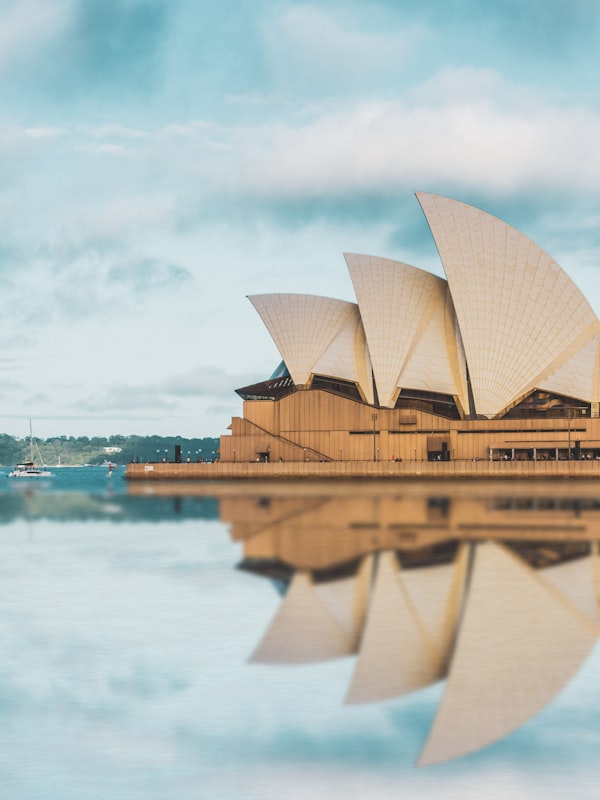
Australia is an attractive destination for those wanting to leave Europe: warm climate, high salaries, and transparent points-based immigration system. All well thought out until you discover that housing is expensive even for Australian salaries, distance from the rest of the world is isolating, and work visa is just first step, not guarantee of residency. Worth it, but for those who know what they want.
Australia at a glance
Languages and regions
English is the official language, spoken by the entire population, with an accent that's distinctive but easy to understand, so there's no language barrier for newcomers. The country is vast, nearly 7.7 million km2, and the population is concentrated on the east coast, in Sydney, Melbourne and Brisbane, and in the southwest, in Perth and Adelaide. Each region has quite different climate and cost of living, from tropical in the north to temperate in the south.
Climate and geography
Australia is a continent-country, and the climate varies widely from region to region: tropical in the north, arid and semi-desert in the interior, temperate in the south, and oceanic on the southern islands, like Tasmania. Sydney has a hot summer, from November to February, and a mild winter. Beaches, reefs and wild nature, with the Great Barrier Reef as its biggest symbol, define the country's landscape. Distance from the rest of the world is real: flights are long, and geographic isolation leaves its mark on local culture.
What the country lives on
The economy is strong in mining (gold, copper, lithium), agriculture, tourism, finance and services, with a real dependence on China as its main ore customer. Technology is also growing, especially in AI startups. Salaries are high, but housing costs in big cities eat up much of that advantage, and the labor market is competitive and values local qualifications, which limits mobility for newcomers.
Education
Public education is good and accessible through high school, and Australian universities, like Sydney, Melbourne and ANU, have a strong reputation worldwide. Higher education costs are high for foreigners, with tuition around AUD 15,000 to 45,000 a year for undergraduate courses. Children of residents have access to public education, but the initial work visa doesn't guarantee this automatically.
Culture and integration
Australian culture is informal, direct, and values a sense of humor and equality. Outdoor life is central, from beaches to barbecues to sports, and multiculturalism is official policy that's actually practiced, with a large presence of immigrants from around the world. Even so, integration can be slow: Australians tend to have closed social circles, and work takes up much of daily energy. Geographic isolation also contributes to Australians valuing local life and long-term friendships.
Fun facts
- The points system for immigration (Skilled Migration) is transparent and based on profession, education and English, with no explicit nationality quota.
- Several time zones divide the country, from the east, in Sydney and Melbourne, to the west, in Perth, which causes frequent logistical confusion.
- Australia has a list of sought-after occupations (Skilled Occupation List), which changes annually according to demand and guides who gets priority in immigration.
- The danger from wildlife is culturally exaggerated: most Australians never encounter a snake or spider, but the fear remains latent.
- The country bans entry of many animals, plants and food, with rigorous quarantine, to protect a unique ecosystem.
Net salary, summarized
Source: national medians (OECD/Eurostat) + calculator formulaJust to show the ballpark of what you earn. Tax and cost of living take a chunk. Three sample professions, junior to senior. The full calculation, for your role, level, family, and currency, is the Living calculator.
Net pay by profession and level
| Profession | Junior | Mid | Senior |
|---|---|---|---|
| Software developer | US$ 6.054 | US$ 7.397 | US$ 11.059 |
| Financial analyst | US$ 4.700 | US$ 5.757 | US$ 8.526 |
| Nurse | US$ 4.238 | US$ 5.195 | US$ 7.709 |
Estimated net monthly, after progressive tax, in dollars (site base). Calculate for your role, level, and currency →
Gross and net by profession
Mid level. The dark part is tax and contributions.
Position among the 50 countries
Dimension by dimension
The fuller the bar, the better the position. The tick marks the median of the 50. Finance is left out of this ruler while the cost base is under review.
Profile against the median
this countrymedian of the 50
Where it wins
English1st of 50Immigration1st of 50Happiness3rd of 50Where it loses
Internet33rd of 50Safety20th of 50Work-life16th of 50Cost of living, what you actually keep
Source: basket for couple + 2 children (Numbeo) + local health and school rules| Housing (rent)≈ 40% of cost | US$ 2.120 |
| Food | US$ 1.145 |
| Transport | US$ 477 |
| Utilities and internet | US$ 413 |
| Recreation and other | US$ 1.145 |
| Healthcare | US$ 30 |
| Children's schoolpublic viable for non-residents | included |
| Total cost per month | US$ 5.330 |
Spending pattern (housing + living only)
Local tax, health, and school rules change how much is left at month end.
Family and immigration
Visa and spouse work rules; local values estimatedQuality of life
Indices: GPI, PISA, WHO, WHR, Ookla, EF EPI, CPI (0 to 10)Life
Daily
Institutions
Verdict
Worth it for professionals in sought occupations (IT, engineering, health, skilled construction) who get work visa or migration by points. Salaries start high, but housing eats the difference quickly, especially in Sydney and Melbourne. Worth less for those who value geographic proximity to family outside Australia, or those who can't handle isolation. The big advantage is political security, solid public health system (Medicare), and quality of life if you get housing. Point of caution: initial work visa (temporary, like 482 or 491) does not guarantee permanent residency, process is lengthy and requires continuing to score.
Complete guide: Australia
This page is the overview. The guide goes deeper.
The guide goes further than this page: visas, taxes, cost of living by region, healthcare, schools, a verdict by profile and the first 90 days, with the main sources listed in the guide.
The guide is delivered in English. Portuguese, Spanish, French, German, Italian and Chinese versions are sent on request after purchase.
- Visa and sponsorship, step by step
- Cities and regions compared
- Health insurance: how to choose
- Retirement, taxes, and local rules
- Useful links: housing, bank, jobs
Frequently asked questions
How does the points-based immigration system work?
Australia maintains lists of sought-after professions (Skilled Occupation List), and you accumulate points for age, English, education, experience and a fluency test (IELTS). The minimum score changes annually according to demand, and some professions, like technology, nursing and skilled construction, are always among the most sought after.
Is housing cost really very high?
Yes. Sydney and Melbourne have rent comparable to London or Zurich, and a room in central Sydney starts from AUD 2,000 a month. The ratio between Australian salaries and rent has deteriorated a lot over the last five years, frustrating many residents.
Is health public or do I need to pay?
Medicare is the public health system for residents, including those with permanent residency. A temporary work visa doesn't give automatic access, so you'd need to take out private insurance or use private services, and medical costs without coverage are high.
What is the time from work visa to permanent residency?
It varies a lot. A temporary work visa (subclasses 482, 494 or 491) lasts 2 to 4 years, and permanent residency (189 or 190) requires passing the points selection again or being sponsored by an employer. Some people spend 5 to 7 years on temporary visas before getting permanent residency.
Latest on this country
Average wages in the OECD, 2025: what a full-time salary is worth in purchasing power
In 2025, the average annual wage per full-time equivalent employee across the OECD was 64,803 US dollars at purchasing power parity. Luxembourg had the highest figure, 98,530, and Mexico the lowest, 24,463. Here are the figures for the 33 member countries with 2025 data.
Top income tax rates in the OECD, 2025: how high they go and where they start
In 2025, the top income tax rate on wages was 55.9% in Denmark and Japan, but Denmark's starts at 1.2 times the average wage and Japan's at 7.7 times. In Colombia, the top rate of 39.0% starts at 51.5 times the average wage. Here is the OECD data for 37 member countries.
Work-life balance in the OECD, 2025: where people work the fewest hours
Workers in Germany put in 1,332 hours on average in 2025, the lowest figure among OECD members, against 1,736 across the OECD. In Mexico and Türkiye, close to one employee in four usually works 50 hours or more a week; in the Netherlands it is 1.8%. Here is the data for 38 OECD members.
Ready to go beyond the summary?
View the complete guide: Australia