

Country dossier · Living
🇰🇷 South Korea
Living guide: real net salary, cost of living, taxes, health and quality of life, with source for every figure.
- Region
- East Asia
- Capital
- Seoul
- Languages
- Korean
- Currency
- South Korean Won (KRW)
- Population
- ≈ 51.7 million
- Time zone
- UTC+9 (KST)
- Blocs
- Outside the EU; no equivalent regional bloc
What this rate includes
Average EFFECTIVE rate for married with kids — blends progressive brackets, contributions and typical deductions; not the marginal rate. It is progressivity-adjusted: incomes below the local anchor effectively pay less, director-level incomes pay more (up to +20%). Where public healthcare is contribution-funded (Germany, Nordics, Japan), it is already included.
Calibration: OECD Taxing Wages · PwC Tax Summaries
South Korea produces a large share of the electronic devices the world uses, pays well those who work in technology, and Seoul is a hyperconnected and safe megacity. All of this is real. But there is also a corporate culture of working hours that extend well beyond scheduled time, competitive pressure that begins in school, and a language barrier that is concrete outside multinationals and international environments. The data below show how much actually remains for those who move, and in which scenarios.
South Korea at a glance
Languages and regions
Korean dominates completely. English works in international corporate environments, technology startups and private hospitals, but outside of that it becomes difficult, from the metro to neighborhood restaurants, banks and documentation. Seoul concentrates almost a quarter of the country's population and is the economic heart, but those who work in technology find opportunities also in other regions and neighboring cities.
Climate and geography
The climate is temperate, with four well-marked seasons. Winter is harsh, especially in Seoul, with temperatures easily below zero, and summer is hot and humid. Spring and autumn tend to be pleasant. The topography is mountainous, with most of the territory sparsely urbanized, despite population concentration in Seoul and the metropolitan region.
What the country lives from
The economy is based on electronics, semiconductors, automotive industry and globally-reaching entertainment. Samsung, LG and Hyundai are not exceptions: they are the standard of a consolidated export force. There is also a growing creative industry, with K-pop, cinema and series, which generates jobs beyond the traditional technology sector.
Education
The educational system is extremely competitive. Pressure for performance in exams begins early and does not stop: paid preparatory courses, evening tutoring classes, fierce competition for places in elite universities. All of this reflects in a school and corporate culture that values the accumulation of hours and nearly unrestricted dedication to study or work.
Culture and integration
Hierarchy by age is strong: formal respect for older people, differences in treatment according to the age of the person you're talking to. Collectivism marks relationships, with the group in first place. The integration of foreigners exists, but the fact of being foreign marks a clear difference, and those who don't speak Korean well tend to remain in the position of being an outsider even after many years in the country.
Fun facts
- Seoul has population density that rivals the largest cities in the world: about 9.6 million inhabitants in the city, which fell below ten million in 2021, and about 25 million in the metropolitan region, all in compact space.
- PC bangs, gaming cybercafes, remain an important cultural stronghold, not just as a gaming space, but as a meeting and socializing place.
- South Korea is among the world leaders in high-speed internet consumption and streaming.
- Spicy food is not a cliché: gochujang, fermented chili paste, is the base of many everyday dishes.
- The wave of K-pop and Korean series created real international demand for creative work in production, marketing and content.
Net salary, summarized
Source: national medians (OECD/Eurostat) + calculator formulaJust to show the ballpark of what you earn. Tax and cost of living take a chunk. Three sample professions, junior to senior. The full calculation, for your role, level, family, and currency, is the Living calculator.
Net pay by profession and level
| Profession | Junior | Mid | Senior |
|---|---|---|---|
| Software developer | US$ 3.603 | US$ 4.432 | US$ 6.626 |
| Financial analyst | US$ 2.778 | US$ 3.422 | US$ 5.134 |
| Nurse | US$ 2.497 | US$ 3.078 | US$ 4.625 |
Estimated net monthly, after progressive tax, in dollars (site base). Calculate for your role, level, and currency →
Gross and net by profession
Mid level. The dark part is tax and contributions.
Position among the 50 countries
Dimension by dimension
The fuller the bar, the better the position. The tick marks the median of the 50. Finance is left out of this ruler while the cost base is under review.
Profile against the median
this countrymedian of the 50
Where it wins
Education2nd of 50Health5th of 50Internet5th of 50Where it loses
Work-life45th of 50English38th of 50Happiness37th of 50Cost of living, what you actually keep
Source: basket for couple + 2 children (Numbeo) + local health and school rules| Housing (rent)≈ 38% of cost | US$ 1.482 |
| Food | US$ 870 |
| Transport | US$ 363 |
| Utilities and internet | US$ 314 |
| Recreation and other | US$ 870 |
| Healthcare | included |
| Children's schoolpublic viable for non-residents | included |
| Total cost per month | US$ 3.900 |
Spending pattern (housing + living only)
Local tax, health, and school rules change how much is left at month end.
Family and immigration
Visa and spouse work rules; local values estimatedQuality of life
Indices: GPI, PISA, WHO, WHR, Ookla, EF EPI, CPI (0 to 10)Life
Daily
Institutions
Verdict
It's worth it for those who work in technology, startups or multinationals that offer full or senior-level salary. Seoul is safe, well-served by infrastructure, and social life revolves quite a bit around work. It's worth less for those at the beginning of their careers, because housing in Seoul consumes 30% to 40% of income even at high salaries. Foreigners tend to form bubbles of coexistence, with expatriate communities concentrated in specific neighborhoods and work social networks also among foreigners, which limits deeper integration. Real point of attention: the long working hours are not an exception nor seen as a problem to solve, it's a cultural norm, even in companies that pay well. The language barrier limits job options outside multinationals and technology in a significant way.
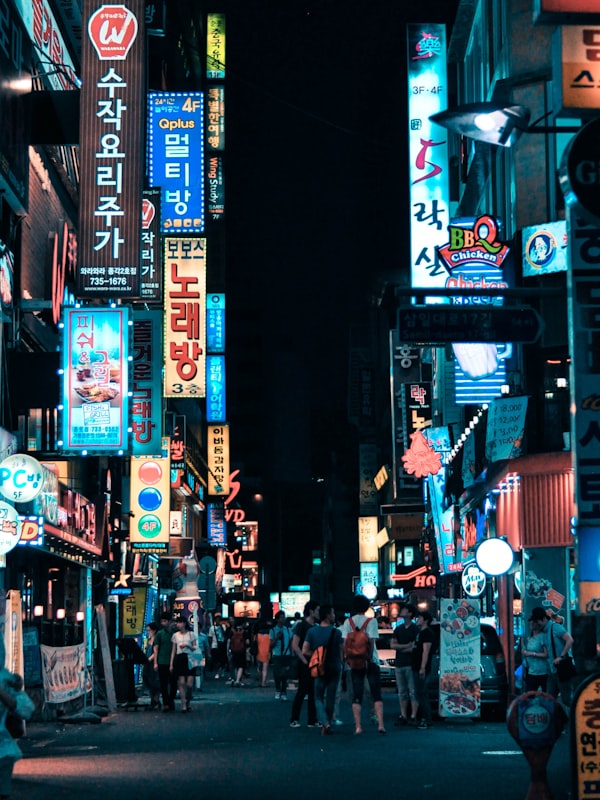
Imagine yourself here.
Complete guide: South Korea
This page is the sample. The guide is the complete map.
Everything you saw here, deeper and actionable: from first visa step to moving day, sourced for every fact.
- Visa and sponsorship, step by step
- Cities and regions compared
- Health insurance: how to choose
- Retirement, taxes, and local rules
- Useful links: housing, bank, jobs
Photos: Robson Hatsukami Morgan, Stéphan Valentin, jet dela cruz · Unsplash
Frequently asked questions
Can you work in South Korea without speaking Korean?
Yes, but with clear restrictions. In multinationals, technology startups and creative sectors, it's possible to get by with just English. Outside of that, the barrier is real: banks, bureaucracy, medical care and daily interactions in neighborhood restaurants require Korean. Many people spend some years in the country without learning the language well because they work and socialize mainly in English, in bubbles of expatriates.
How does the work visa for foreigners work?
South Korea operates by employer sponsorship system. The work visa requires that a Korean company, or the local branch of a multinational, request the visa with job guarantee. Without confirmed offer, it's difficult to enter with a work visa. There are also categories for investors and entrepreneurs, which require significant capital.
If I get a job there, can my spouse work too?
Spouses of work visa holders can obtain dependent visa. With this visa, the spouse needs to request separate authorization to work, and generally succeeds, but not automatically: the employer needs to confirm the hiring. The process is possible, but depends on the case and the type of work the spouse is looking for.
Why is it so expensive to live in Seoul even in well-paid sectors?
Seoul is a megacity of more than ten million people, with housing costs among the highest in the world. A small apartment in a residential neighborhood already has significant rent. Food is relatively cheap and transportation is efficient, but housing consumes a high proportion of income even at high salaries. An alternative is to live in neighboring cities and face longer commuting, which consumes time in a routine that already tends to be demanding.
Ready to go beyond the summary?
View the complete guide: South Korea